
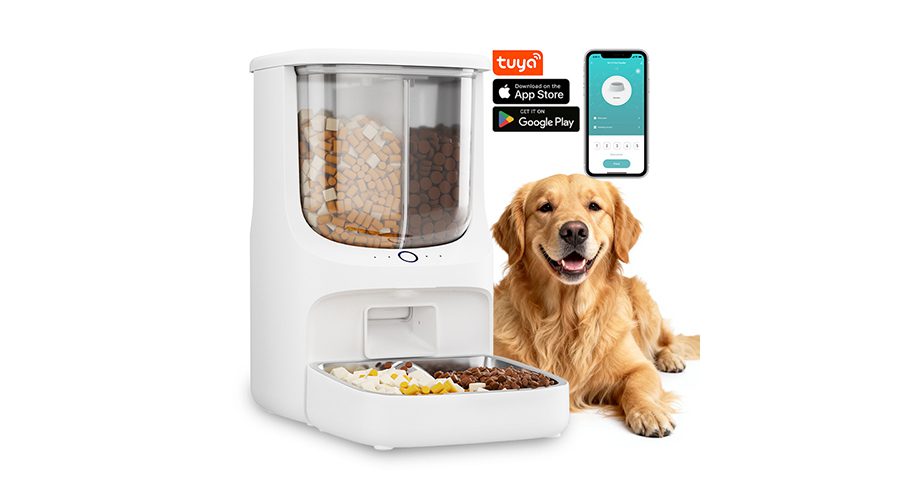
A 5L capacity is one of the most popular sizes for automatic cat feeders. But is it enough for a multi-cat household? The answer depends on how many cats you have, how much each cat eats, and how long you need the feeder to last.
The capacity math
A typical cat eats 50-80 grams of dry food per day (approximately 1/4 to 1/3 cup). Let’s calculate:
- 1 cat at 60g/day: 5L lasts approximately 12-14 days
- 2 cats at 60g/day each: 5L lasts approximately 6-7 days
- 3 cats at 60g/day each: 5L lasts approximately 4-5 days
These are estimates — actual consumption varies based on cat size, activity level, and food calorie density.
When 5L is enough
Two cats, daily monitoring. If you check the feeder daily and refill as needed, 5L provides a comfortable buffer.
Two cats, short absences. For weekend trips (2-3 days), 5L is more than sufficient for two cats.
Three cats, very short absences. For overnight stays or short days out, 5L handles three cats adequately.
When 5L isn’t enough
Three or more cats, extended absences. If you’re away for more than 3-4 days with three cats, 5L may run dry.
Large cats or high-activity cats. Larger breeds and more active cats eat more — potentially 80-100g per day.
Multiple meals per day. If you program 3+ meals per day with generous portions, the 5L capacity depletes faster.
Dual outlet consideration
For multi-cat households, dual-outlet feeders are often more important than pure capacity:
Physical separation prevents food aggression and ensures both cats get their portion.
Individual portion control lets you set different amounts for different cats (useful when cats have different dietary needs).
Simultaneous feeding means both cats eat at the same time, reducing stress and conflict.
The bottom line
A 5L feeder is sufficient for most two-cat households and adequate for three cats with regular monitoring. For larger households or extended absences, consider 6L+ capacity or multiple feeders. Regardless of capacity, dual outlets are often more important than pure volume for multi-cat households.
