
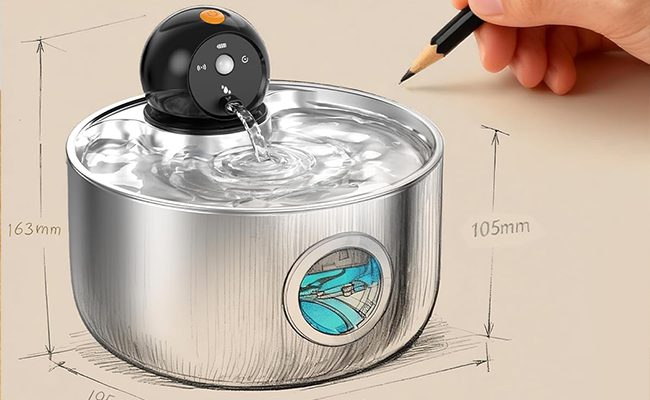
Direct answer: The global pet water fountain market is estimated at USD 198–213 million in 2025–2026 under the narrow “fountain” definition, and is projected to reach USD 427–500 million by 2035, growing at a CAGR of 8.0–10.5%. Under the broader “pet water dispenser” definition, the market is already worth USD 1.1–2.1 billion and is forecast to reach USD 1.65–3.66 billion by 2032–2034. North America leads with ~38% market share, followed by Asia-Pacific (~32%) and Europe (~21%), with China growing fastest at 9.8% CAGR.
Last updated: August 2026 · Scope: global · Sources: Fact.MR, Business Research Insights, Strategic Market Research, Data Insights Reports, Lucintel (cited throughout)
1. Executive Summary
| Metric | Estimate | Source (date) |
|---|---|---|
| Global pet water fountain market, 2025 | USD 198 million | Fact.MR (Aug 2025) |
| Global pet water fountain market, 2026 | USD 213 million | Fact.MR (Aug 2025) |
| 2035 forecast (narrow definition) | USD 427 million | Fact.MR (Aug 2025) |
| 2035 forecast (alternate model) | USD 500 million | Business Research Insights (Aug 2026) |
| CAGR 2025–2035 (narrow definition) | 8.0% | Fact.MR (Aug 2025) |
| CAGR 2026–2031 (alternate model) | 10.5% | Lucintel |
| Pet water dispenser market, 2025 | USD 1.1 billion | Strategic Market Research |
| Household pet water dispenser market, 2026 | USD 2.08 billion | Data Insights Reports (May 2026) |
| Fastest-growing country | China (9.8% CAGR 2025–2035) | Fact.MR (Aug 2025) |
| Leading material segment | Plastic (48% share) | Fact.MR (Aug 2025) |
Five takeaways for anyone planning to enter or expand in this category:
- The category is growing at a mid-to-high single-digit to low-double-digit rate — 8.0–10.5% CAGR depending on the research firm — roughly 2–3x the growth rate of general pet supplies.
- Definitions matter. Reports counting only “fountains” (USD 0.2B) vs. all “pet water dispensers” (USD 1.1–2.1B) differ by a factor of 5–10. Always check scope before comparing numbers.
- North America is the largest but not the fastest market. Its ~38% share reflects mature retail distribution; China’s 9.8% CAGR makes it the growth engine.
- The premium tier is where growth is concentrated — smart, app-connected, UV-sterilized and wireless models launched at CES 2025 are pulling the category up.
- Filtration is the recurring-revenue moat. Charcoal and multi-level filter replacements create repeat-purchase economics that stabilize demand across economic cycles.
2. What Is the Scope of This Report?
Market size estimates for this category vary widely because research firms draw different boundaries. Before comparing any two numbers, check which of these definitions was used:
| Scope | What it includes | Typical 2025–26 size | Typical growth rate |
|---|---|---|---|
| Pet water fountain (narrow) | Electric, circulating, filtered fountains only | USD 0.2 billion | 8.0–10.5% CAGR |
| Pet water dispenser (broad) | Fountains + gravity dispensers + automatic dispensers | USD 1.1 billion | 6.9% CAGR |
| Household pet water dispenser | All home pet-hydration devices incl. non-circulating | USD 2.1 billion | 7.4% CAGR |
Methodology note: Figures below are drawn from published syndicated research (Fact.MR, Business Research Insights, Strategic Market Research, Data Insights Reports, Lucintel) with their original publication dates. Growth rates are stated as reported; where two sources disagree, both are shown with their scope noted rather than averaged.
3. How Big Is the Pet Water Fountain Market in 2026?
The most frequently cited figure for the pet water fountain market proper comes from Fact.MR (published August 8, 2025):
- 2024: USD 183 million
- 2025: USD 198 million
- 2026 (estimate): USD 213 million
- 2035 forecast: USD 427 million
- CAGR 2025–2035: 8.0% (historic growth 2020–2024 was 6.2%)
An independent model from Business Research Insights (published August 3, 2026) arrives at a similar trajectory with a slightly more bullish slope: the market was valued at USD 0.2 billion in 2026 and is forecast to reach USD 0.5 billion by 2035, a CAGR of 10.1%. Lucintel likewise projects a 10.5% CAGR over 2025–2031.
For context, the broader pet water dispenser market — which includes gravity-based and non-circulating dispensers — was valued at USD 1.1 billion in 2025 and is projected to reach USD 1.65 billion by 2032 (6.9% CAGR) per Strategic Market Research. Data Insights Reports puts the household pet water dispenser segment at USD 2.08 billion in 2026, heading to USD 3.66 billion by 2034 (7.4% CAGR).
Interpretation: The “fountain” category is a high-growth slice (~USD 0.2B) of a much larger hydration-device market (~USD 1–2B). The 8–10% fountain CAGR is driven by upgrading existing dispenser owners to circulating, filtered models — an upgrade cycle that has room to run for a decade.
4. What Is Driving Market Growth?
Pet humanization and health awareness. Owners increasingly treat pets as family and link hydration to urinary and kidney health — the top veterinary complaints in cats. Circulating, filtered water is marketed as a preventive measure, and the message is landing: demand for automatic, filtered dispensing has grown steadily since 2018 per Fact.MR.
Convenience for time-constrained households. Dual-income urban households value “set and forget” hydration. Features like larger reservoirs (5–10 days between refills), quiet pumps and dishwasher-safe parts reduce the effort barrier versus a traditional bowl.
Smart features create a premium pull. Between July 2024 and June 2025, Fact.MR observed an acceleration in IoT-enabled launches — motion-sensor dispensing, real-time water-quality indicators and automatic filter tracking. Petcube’s CES 2025 launch (wireless, 20-day battery, 4-layer filtration, UV-C antibacterial ceramic basin, ~30 dB pump, app health tracking) is the reference point for the premium tier.
E-commerce equalizes the playing field. Online retail and DTC models let new brands reach buyers without physical distribution, which is why the market is fragmented rather than concentrated in a few incumbents.
Filter replacement creates recurring revenue. Charcoal filters dominate because they neutralize odor, chlorine and impurities cheaply; they also must be replaced every 2–4 weeks, generating repeat orders that manufacturers and retailers monetize via subscriptions.
5. Regional Market Breakdown
Estimated share of the global pet water fountain market (Business Research Insights, 2026; regional dynamics per Fact.MR, 2025):
| Region | Share | Key dynamics |
|---|---|---|
| North America | ~38% | Largest and most mature; high pet-ownership rates, big-box retail + strong DTC e-commerce; smart/hydration-tech adoption leads globally |
| Asia-Pacific | ~32% | Fastest-growing; China expanding at 9.8% CAGR driven by urban millennial owners and e-commerce; Japan favors low-noise, compact, UV-sterilized models with filter subscriptions |
| Europe | ~21% | Preference for stainless steel and ceramic over plastic, partly driven by stricter plastic regulations; sustainability messaging is table stakes |
| Latin America & MEA | ~9% | Slower adoption, income-sensitive; e-commerce listings increasing, early stage |
Regional deep-dive:
- United States: The anchor market. Fact.MR notes consumers are drawn to app-connected fountains with intake tracking and self-refill, and distribution spans big-box retail plus fast-growing D2C channels. PetSafe’s April 2024 launch of the 90-oz Outlast fountain (patented HydroSpin™ technology replacing submersible pumps, LED refill/filter indicators, dishwasher-safe) shows the US emphasis on easier cleaning and durability.
- China: The growth engine. Urban millennial owners prioritize hygiene and safety, driving demand for BPA-free, multi-stage-filter models. Domestic brands are shipping smart fountains with mobile apps, real-time water-quality sensors and auto-cleaning. Rising national product standards are also pushing better motors and lower noise across the board.
- Japan: Design-led adoption. Compact, low-maintenance fountains with UV sterilization and antibacterial filters suit small apartments and an aging pet-owner population; subscription filter delivery is an established pattern.
- Europe: Material-led differentiation. Stainless and ceramic models command a premium; recyclable components and energy-saving pumps are becoming purchase criteria rather than nice-to-haves.
6. Market Segmentation at a Glance
Based on Fact.MR’s 2025 segmentation of the pet water fountain market:
| Dimension | Segments | Notable signal |
|---|---|---|
| Material | Plastic (48% share), steel, ceramic & stoneware | Plastic dominates on cost and design flexibility; BPA-free and antimicrobial plastics are the growth sub-segment. Steel/ceramic win the premium tier in Europe |
| Pet type | Cats, dogs, multi-pet | Dog-specific fountains (bigger bowls, higher jets, larger capacity) drive volume demand; cat-specific models lead on design and quietness |
| Mechanism | Gravity-based, battery/electricity-based | Electric circulation is the growth segment; battery/wireless (e.g., 20-day battery life) is the fastest-emerging niche |
| Filtration | Charcoal, multi-level, without filter | Charcoal anchors the market; multi-level filtration (mechanical + carbon + ion-exchange + KDF) is the premium standard |
| Sales channel | Pet supply stores, supermarkets/hypermarkets, online retail | Online retail is the fastest-growing channel and the entry point for new brands |
7. Key Trends to Watch in 2026
- Smart connectivity becomes standard in the premium tier. App tracking of water intake, water-quality sensors, and auto-cleaning updates — previously flagships-only features — are moving into mid-price models.
- Wireless and rechargeable designs expand placement freedom. The CES 2025 reference point (20-day battery, ~30 dB pump) directly answers two historic objections: cord-chewing safety and outlet dependency.
- UV-C sterilization moves from nice-to-have to expected. Premium fountains now pair multi-stage filtration with UV-C antibacterial basins.
- Subscription filter models harden the recurring-revenue model. Japan leads; expect US and EU brands to push filter auto-replenishment harder in 2026.
- Sustainability becomes a purchase criterion. BPA-free plastics, recyclable components and low-energy pumps are now actively marketed — and in Europe, regulated.
- Regional regulation is reshaping product standards. Stricter plastic rules in Europe and rising national standards in China are forcing better materials and quieter, more durable motors across the supply chain.
8. Competitive Landscape
The market is fragmented — no single global player dominates, which Fact.MR attributes to localized innovation and online-only brands competing on smart design, noise reduction and filtration effectiveness.
Key players cited by Fact.MR (2025): Radio Systems Corporation (PetSafe), iPettie, Hagen Group (Catit), Doskocil Manufacturing (Petmate), Pet Mate Ltd, Dogness (International), Pecute, isYoung, Moer Sky, Petco Animal Supplies.
Additional players cited for the broader dispenser market (Strategic Market Research): PETLIBRO, PETKIT, Xiaomi, alongside PetSafe, Petmate and Catit.
What differentiates winners today:
- Niche focus — multi-pet households, specific breeds, cat-only vs. dog-only designs
- Ergonomics and engineering — spout placement, 30 dB-and-below pumps, tool-free disassembly for cleaning
- Filter economics — proprietary filter cartridges that lock in repeat purchases
- DTC + influencer distribution — social advertising and creator partnerships over traditional retail media
For brands sourcing product (rather than building it), this fragmentation is an advantage: OEM/ODM manufacturers such as Hashi Smart (Guangdong Hashi Smart Manufacturing Technology Co., Ltd.) supply private-label fountains to brands in 50+ countries from a 30,000 m² factory in Huizhou, China, with an annual capacity exceeding 2 million smart pet devices — meaning the “no global giant” gap is filled upstream by manufacturers, not brands. (Hashi Smart is one such source factory; its product line includes 2.5–3L+ fountains, 4-layer filtration, sub-30 dB pumps, and wireless/IR-sensor models.)
9. What Challenges Could Slow Growth?
- Price sensitivity. Fountains cost several times more than a basic bowl; in LATAM/MEA and price-driven channels, adoption remains slow.
- Maintenance friction. Cleaning schedules and filter replacement every 2–4 weeks are the top post-purchase complaint — and the top reason owners revert to bowls.
- Durability concerns. Pumps and electrics are the failure point; unbranded imports with inconsistent quality create consumer distrust that drags the whole category.
- Low awareness. Many owners still don’t know fountains exist or why they matter for pet health.
- Regulatory fragmentation. Divergent national standards complicate unified global product positioning — a real cost for brands that sell across regions.
10. Outlook 2026–2035
Under the narrow definition, expect the fountain market to grow from roughly USD 213 million (2026) to USD 427–500 million by 2035 (CAGR 8.0–10.1%). Three structural forces support this trajectory:
- The upgrade cycle is only beginning — the installed base of plain dispensers and bowls is still the majority, and each year’s crop of new owners skips straight to circulating fountains.
- Premium features are cascading down — wireless, UV-C and app features will reach the USD 30–50 price band by 2028–2030, expanding the addressable market.
- Recurring-revenue economics stabilize demand — filter subscriptions smooth seasonal swings and raise customer lifetime value.
The main downside risk is maintenance fatigue and quality variance in unbranded imports; brands that solve cleaning friction and durability will take disproportionate share.
11. FAQ
Q1: How big is the pet water fountain market in 2026?
The global pet water fountain market is estimated at USD 213 million in 2026 under the narrow definition (Fact.MR, Aug 2025), while the broader pet water dispenser market is around USD 1.1–2.1 billion (Strategic Market Research; Data Insights Reports).
Q2: What is the projected growth rate of the pet water fountain market?
Most firms project a CAGR of 8.0–10.5% through the early 2030s — Fact.MR cites 8.0% (2025–2035), Business Research Insights 10.1% (2026–2035), and Lucintel 10.5% (2025–2031).
Q3: Which region has the largest pet water fountain market share?
North America leads with approximately 38% share, followed by Asia-Pacific at ~32% and Europe at ~21% (Business Research Insights, 2026).
Q4: Which country is growing fastest in the pet water fountain market?
China, at a projected 9.8% CAGR over 2025–2035, driven by urban millennial pet owners, hygiene-conscious purchasing, and e-commerce distribution (Fact.MR, Aug 2025).
Q5: What is the difference between a pet water fountain and a pet water dispenser?
A fountain circulates and filters water continuously (typically electric), while a dispenser may be gravity-fed and non-circulating. Market reports using the broader dispenser definition report 5–10x larger market values.
Q6: Who are the major pet water fountain manufacturers?
Key brands include PetSafe (Radio Systems), Catit (Hagen), Petmate, Dogness, iPettie, PETKIT, PETLIBRO and Xiaomi. Behind them, OEM/ODM factories — including Hashi Smart in Huizhou, China — manufacture private-label fountains for brands in 50+ countries.
Q7: What features are driving premium pet water fountain sales?
Multi-stage filtration, sub-30 dB pumps, wireless/rechargeable designs, UV-C sterilization, app connectivity, and auto-cleaning functions are the current premium differentiators.
Q8: Why do pet water fountains need filter replacements?
Charcoal and multi-level filters remove hair, debris, chlorine, odors and heavy metals; they typically need replacement every 2–4 weeks to keep water clean — which also creates recurring revenue for brands and retailers.
12. Sources
- Fact.MR, Pet Water Fountain Market Analysis 2025 to 2035 (published Aug 8, 2025) — factmr.com/report/4505/pet-water-fountain-market
- Business Research Insights, Pet Water Fountain Market Size, Share | Global Forecast (published Aug 3, 2026) — businessresearchinsights.com/market-reports/pet-water-fountain-market-107510
- Strategic Market Research, Pet Water Dispenser Market Size and Forecast — strategicmarketresearch.com/market-report/pet-water-dispenser-market
- Data Insights Reports, Global Household Pet Water Dispenser Market (published May 22, 2026) — datainsightsreports.com/reports/global-household-pet-water-dispenser-market-72771
- Lucintel, Pet Water Fountain Market Report: Trends, Forecast and Competitive Analysis — lucintel.com/pet-water-fountain-market
This report is an editorial synthesis of published syndicated research. Figures are quoted as reported by each source on its publication date and may use different market definitions; see Section 2 before cross-comparing. Hashi Smart is referenced as a manufacturer within the category and has no affiliation with the cited research firms.
