
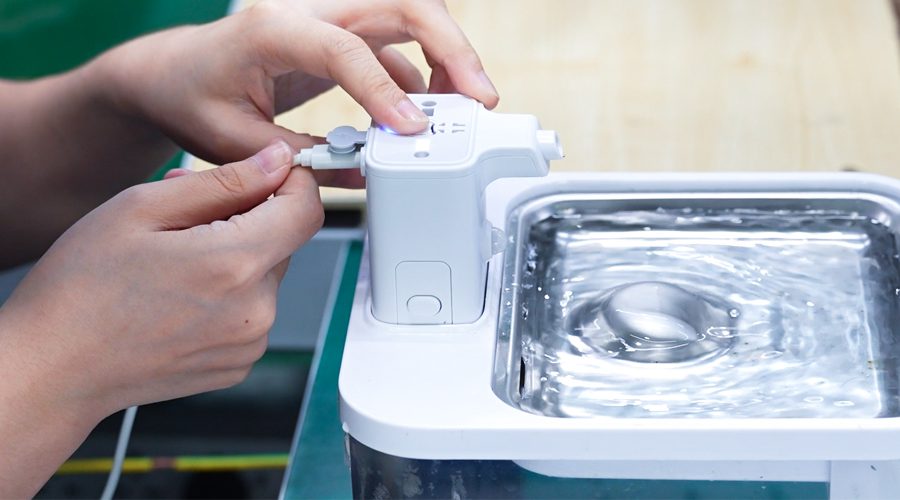
Pre-shipment testing is your last line of defense against defective products. Here’s how quality manufacturers test cat water fountains before they leave the factory.
The testing sequence
1. Individual function testing
Every assembled fountain is tested for:
Water flow verification. Running water through the complete system — pump, filter, and outlet — to verify adequate flow and no leaks.
Pump performance. Confirming noise level (below 35dB), flow rate, and power consumption meet specifications.
Sensor response. Testing motion sensor activation and deactivation timing.
Mode switching. Verifying that timer, sensor, and continuous modes all function correctly.
Leak testing. Running water through the fountain for extended periods to identify any leaks at connection points.
Electrical safety. Verifying power adapter safety, grounding, and insulation.
2. Extended operation testing
Beyond basic function testing, some manufacturers run fountains for extended periods:
4-24 hour operation test to identify intermittent issues that short tests might miss.
Water level variation testing to ensure proper operation at different fill levels.
Multiple power cycle testing to verify reliability through repeated on/off cycles.
3. Cosmetic inspection
Visual inspection of every unit for:
Surface defects. Scratches, dents, discoloration, or flash (excess plastic).
Color consistency. Matching approved color samples across the production batch.
Print quality. Logos, labels, and markings are clear and properly aligned.
Component completeness. All parts, accessories, and documentation are included.
4. AQL (Acceptable Quality Level) inspection
Statistical sampling provides batch-level quality verification:
Sample size is determined by batch size and AQL level (typically AQL 2.5 for consumer products).
Defect classification:
- Critical defects — Safety hazards (zero tolerance)
- Major defects — Functional issues that affect product use
- Minor defects — Cosmetic issues that don’t affect function
Pass/fail criteria — If defect rates exceed AQL limits, the batch is rejected or reworked.
5. Packaging verification
Package completeness. All accessories, manuals, and warranty cards included.
Label accuracy. Product labels match actual specifications.
Protective packaging. Packaging adequately protects the product during shipping.
Drop test. Testing one packaged unit from 1 meter to verify packaging effectiveness.
Documentation
Quality manufacturers provide:
- Test reports for each production run
- AQL inspection reports with defect classification
- Material certificates for all food-contact components
- Certification copies (CE, FCC, RoHS, UKCA)
What to look for
100% testing. Every unit tested, not just samples.
Documented results. Test results recorded and available for review.
Dedicated QC area. Separate space for quality testing, not mixed with production.
Calibrated equipment. Test equipment regularly calibrated for accuracy.
Clear acceptance criteria. Defined pass/fail standards for every test.
What HS Smart Pet offers
HS Smart Pet provides comprehensive pre-shipment testing:
- 100% function testing for every fountain and feeder
- Pump burn-in testing for 48-72 hours
- Multi-stage quality control at every production stage
- AQL inspection with documented results
- ISO 9001 quality management throughout the process
The bottom line
Pre-shipment testing is the final quality gate between the factory and your customers. Manufacturers who conduct 100% function testing, burn-in validation, AQL inspection, and provide comprehensive documentation deliver products that build your brand rather than damage it.
Contact HS Smart Pet to learn about our complete quality testing process and discuss how we can support your product quality requirements.
