
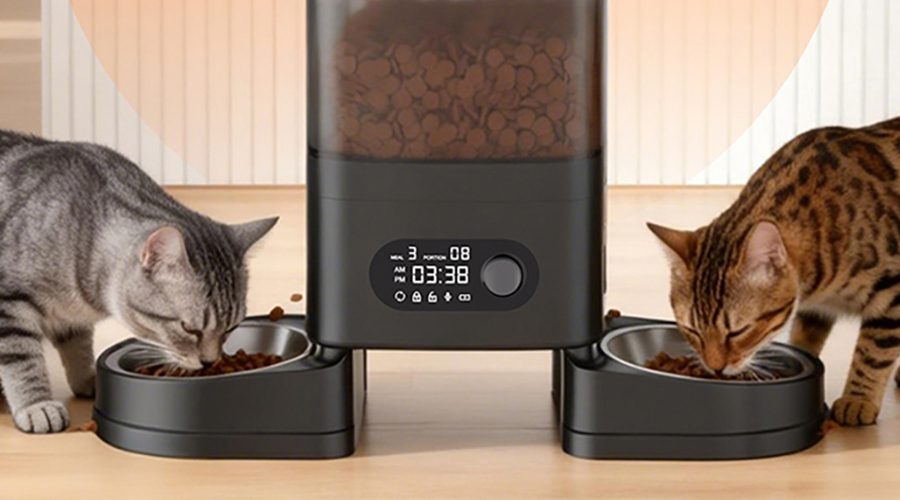
Choosing the right feeder capacity balances convenience with food freshness. Too small and you’re constantly refilling. Too large and food sits in the hopper too long, losing freshness and nutritional value.
Capacity comparison
3L capacity
Best for: Single cat, short absences (1-3 days)
- Holds approximately 1.2-1.5 kg of dry food
- Lasts 7-10 days for one cat (at 120-150g/day)
- Compact footprint — fits in tight spaces
- Food stays fresh because turnover is faster
4L capacity
Best for: Single cat or two small cats, moderate absences (3-5 days)
- Holds approximately 1.5-2 kg of dry food
- Lasts 10-14 days for one cat
- Good balance of capacity and freshness
- Available in models with WiFi control and dual outlets
HS Smart Pet’s 4L smart feeder includes WiFi app control and dual food outlets.
5L capacity
Best for: Two cats or single cat with long absences (5-7 days)
- Holds approximately 2-2.5 kg of dry food
- Lasts 5-7 days for two cats
- The most popular capacity for multi-cat households
- Available in models with WiFi, camera, and dual hoppers
HS Smart Pet’s 5L WiFi feeder includes camera and dual hopper design.
6L capacity
Best for: Three or more cats, extended absences (7+ days)
- Holds approximately 2.5-3 kg of dry food
- Lasts 5-7 days for three cats
- Maximum capacity for heavy-use households
- Largest footprint — measure your space first
Freshness considerations
Larger capacities mean food sits longer in the hopper:
- Keep hopper sealed when not in use
- Use desiccant packs to absorb moisture and maintain freshness
- Don’t overfill — only add food for 5-7 days at a time
- Store backup food in airtight containers, not in the hopper
The practical recommendation
- Single cat: 3L-4L
- Two cats: 4L-5L
- Three+ cats: 5L-6L or multiple feeders
The bottom line
Match feeder capacity to your household size and absence patterns. For most households, 4L-5L provides the right balance of convenience and freshness.
