
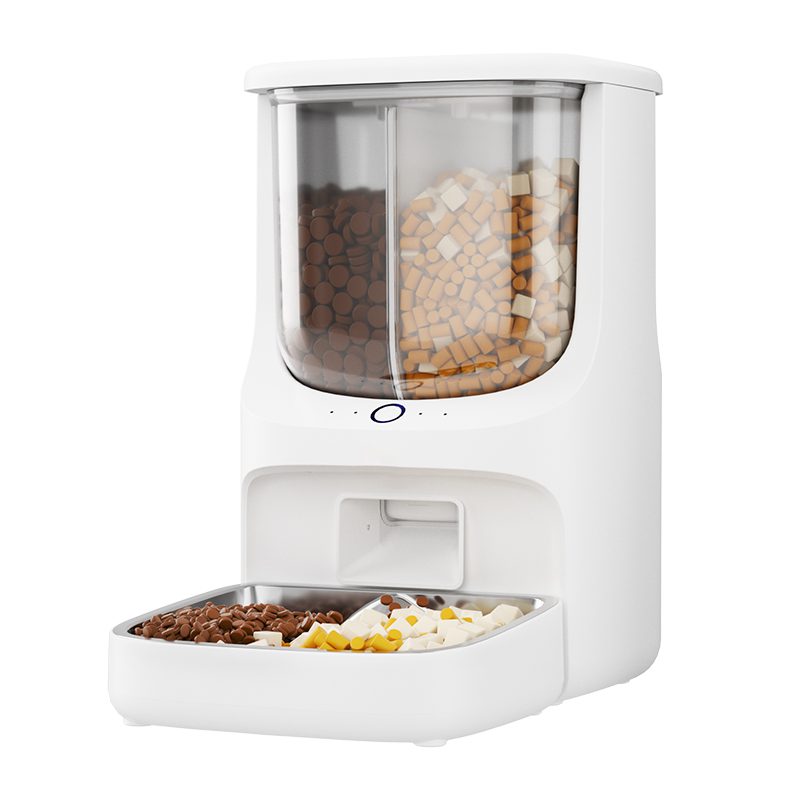
The real question a camera feeder answers is “did she actually eat?” — not “is the schedule set.” Before buying: prefer dual cameras (wide room view + bowl close-up) over a single compromised lens; verify the anti-jam mechanism against your kibble size (jamming is the #1 complaint in the category); confirm dual power with schedule memory so blackout feeding survives; and check two-way audio and app platform (Tuya-based ecosystems are the current stability standard). A 5L dual-compartment unit covers 3-5 days for multi-pet homes.
The most common sentence in pet-owner forums about automatic feeders isn’t about portion control. It’s this:
“How do I know she actually ate?”
Feeding schedules solve the “when.” Cameras solve the “whether.” That’s why feeders with built-in cameras have become the fastest-moving premium tier in the category — and why every spec sheet suddenly claims “HD monitoring.” Here’s how to tell a camera feeder that actually answers the question from one that checks a marketing box.
How we put this guide together
Built from three inputs. First, aggregated owner feedback across Reddit (r/cats, r/petfree, r/homeautomation) and Amazon verified reviews at the 6-month mark — where camera features proved useful, and where they disappointed. Second, component-level evaluation of feeder platforms we manufacture: camera configurations, auger geometry, power-switching behavior, and app ecosystems. Third, category-wide complaint patterns — specifically which failures drive returns, because those are the ones a buyer’s checklist should eliminate before purchase, not after.
Owner reports were weighted over spec sheets wherever the two conflicted. Cameras, in particular, generate optimistic marketing and very specific owner caveats about night-mode resolution.
The core question: one camera or two?
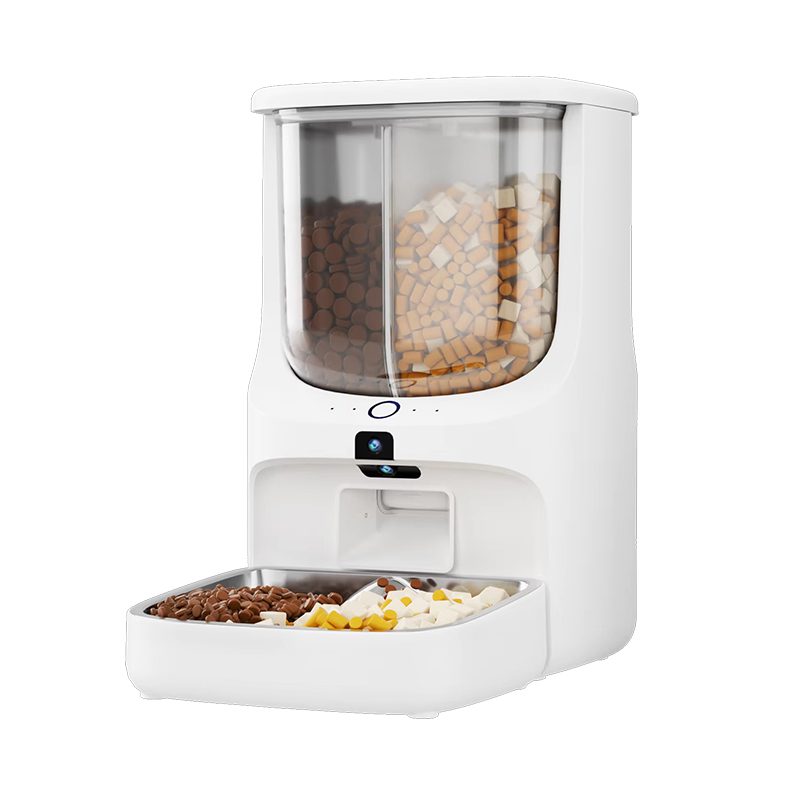
A single lens forces a compromise you’ll feel daily. Wide angle → you see the room, but the food bowl is a few pixels. Close-up → the bowl is clear, but you’ve lost sight of the cat approaching, entering, and leaving — the behavior around the meal, which is often what owners actually want to check.
Dual-camera designs split the job properly:
- Wide-angle lens — panoramic coverage of the feeding environment: who came, how long they stayed, who got chased off the bowl.
- Close-up lens — locked on the food bowl: did food actually dispense, how much is left, is the cat eating right now.
One glance delivers “cat came, food dispensed, bowl now empty” — the full story instead of a fragment. It’s the difference between a security camera and a status check. For multi-pet homes specifically, the wide lens answers the question the bowl camera never can: which cat ate.
| Camera setup | What you can verify | What you can’t |
|---|---|---|
| Single wide-angle | Room activity, cat visits | Whether food actually left the hopper; bowl level |
| Single close-up | Bowl state | Who approached; approach/leave timing; room context |
| Dual (wide + bowl) | Full sequence: approach → dispense → eating → departure | Nothing routine — this is the configuration that ends the “did she eat” text messages |
Four features that decide whether you trust it
1. Two-way audio
Hearing your cat — and being heard — turns monitoring into interaction. Owners use it to calm anxious cats, interrupt over-eaters, and generally stop feeling guilty about the business trip. In reviews, it’s consistently ranked #1 in “features I didn’t know I needed” after two months of real use.
2. Anti-jam mechanics, not anti-jam marketing
Food jams are the number-one functional complaint across the entire feeder category — the phrase “sounds like it’s eating gravel” appears in reviews of badly designed units with alarming frequency. Look for the actual mechanism: spiral auger geometry, elastic silicone paddles, tested against your kibble size. Large, irregular, or freeze-dried pieces are the jam trigger; a feeder specified for uniform dry kibble may misbehave the moment you switch foods. Some designs cut jam rates dramatically (our dual anti-jam structure — spiral blades plus silicone paddles — is specified at roughly 92% fewer jams in testing) — but the number matters less than knowing the supplier tested with mixed food types, not just lab-standard pellets.
3. UV sterilization at the outlet
Bowl-area bacteria is the quiet downside of “food sits there for hours.” A UV light that activates around each dispense reduces microbial load in the bowl zone — genuinely new hygiene layer, and increasingly a checkbox in European buyers’ sourcing requirements. Verify it activates on every dispense cycle, not only on a schedule.
4. Dual power with real failover
Mains power for daily efficiency, battery backup for outages. Two specs actually matter: hours of protected feeding on battery, and whether the clock and schedule survive the switch. A feeder that loses its program during a blackout defeats the entire purpose — ask specifically, because some budget units reboot to factory time.
Capacity: match the hopper to the trip
For a 5L dual-compartment unit: multi-pet homes and large breeds run 3-5 days comfortably per fill; single cats stretch longer. Dual compartments earn their space if you mix kibble with freeze-dried toppers or supplements — the two food types stay separate until dispense, which matters for picky eaters and special diets alike.
Transparent bins with a visible level beat opaque ones every time; you’ll refill on schedule instead of discovering the empty through the empty bowl. Moisture sealing (sealing ring + desiccant box) is the detail that keeps month-old kibble fresh in humid climates.
| Household | Recommended capacity | Compartments | Camera priority |
|---|---|---|---|
| Single cat, short trips | 4-5L | Single is fine | Bowl close-up is enough |
| Two cats, regular schedule | 5L | Dual (food + topper) or dual bowl | Wide lens matters — verify who ate |
| Multi-cat / large breeds | 5L+, check fill line every 3-5 days | Dual compartment strongly preferred | Both lenses |
| Anxious or special-diet cats | 5L | Dual | Two-way audio + bowl lens for medication food check |
Spec checklist before you order
Whether buying one unit or placing a private-label container order, run the checklist:
- Both cameras, specified separately. Resolution and field of view for each lens — not a single “HD” number covering the product. Night mode resolution for both; ask for a sample night screenshot, not a spec-sheet claim.
- Anti-jam test with your food. Send the supplier your kibble spec (size, shape, freeze-dried mix if any) and request dispense-test results. Or run it yourself on samples: 100 dispenses, count the failures.
- Power failover drill. Pull the plug mid-schedule on a sample. Confirm feeding continues, time stays correct, and the app reconnects without re-pairing.
- App platform and multi-user access. Tuya-based ecosystems are the current standard for stable remote control. Confirm family members and temporary pet sitters can get dispensing rights without sharing a login.
- Portion precision and schedule granularity. Minute-level scheduling, defined gram portions per dispense — verify with a kitchen scale across 10 cycles, not one.
- Food-contact certifications. Every part that touches kibble, with documentation. And carton dimensions for your shelf or FBA plan — the unglamorous number that decides landed margin.
Camera feeders fail buyers in ways that have nothing to do with megapixels. Return-rate data across the category concentrates in three mechanical areas: jam geometry (food-dependent — which is why we test with client food, not our own), power-switch behavior (a feeder that resets its clock in an outage becomes a pumpkin at midnight), and app dependency (if the brand’s cloud shuts down, a “smart” feeder becomes a dumb brick — local schedule memory after app disconnection is a specification worth demanding). Cameras are the headline feature; auger, power, and firmware are the features that decide whether customers buy again. These are the three questions we answer first in private label development, before any discussion of housing color.
The honest limitation
Cameras tell you what happened; they can’t force a shy cat to eat on frame, and most cats ignore the lens within a week — which is actually good news: it means the feeder has become furniture rather than a novelty. What they eliminate is the specific anxiety of a blank schedule you can’t verify. For owners away from home, that’s the entire point.
Also worth saying: cameras don’t replace the mechanical fundamentals. A beautiful live feed over a jammed auger is a very expensive way to watch a bowl not refill.
Frequently Asked Questions (FAQ)
Do cat feeders with cameras work in the dark?
Expect infrared or low-light capability on both lenses for nighttime checks. Confirm night-mode resolution — some “HD” cameras drop to grainy grayscale after dark, which is fine for “is she there?” but weak for bowl verification. Ask for an actual night sample image.
Will the feeder keep feeding during a power outage?
If it has battery backup, yes — but check whether the feeding schedule itself survives the switch. Quality dual-power designs keep clock and program intact; the battery replaces wall power, not memory. Test it on a sample before committing to volume.
How long does a 5L feeder last for two cats?
Typically 3-5 days for two average cats on dry kibble, less if the hopper dispenses generous portions. Dual compartments extend flexibility more than raw days — toppers and supplements don’t compete for main-food space. Check the transparent level window weekly rather than trusting the app estimate.
Can multiple family members control the same feeder?
App-based feeders generally support multi-user access. Confirm before buying — especially for households where a pet sitter needs temporary dispensing rights, and for the case where you change app ecosystems later (local schedule memory protects against that).
Do camera feeders really reduce separation anxiety?
For owners, measurably yes — the “did she eat” loop is the anxiety. For cats, the two-way audio feature is what they respond to; the camera itself is invisible to them within days. Reviewers consistently report the audio call feature as the emotional core of the product.
Is UV sterilization a gimmick?
It’s real but bounded: UV at the dispense outlet reduces microbial load around the bowl during feeding cycles — it doesn’t sterilize stored food or the whole unit. Treat it as a meaningful hygiene layer on top of the fundamentals (sealed hopper, desiccant, weekly bowl wash), not a substitute for them.
Need camera feeder specifications, food-type jam testing, samples, or a private label quote? Contact HS Smart Pet — in-house assembly lines with 100,000+ units monthly output, FBA prep support, and full private label customization including app branding.
