
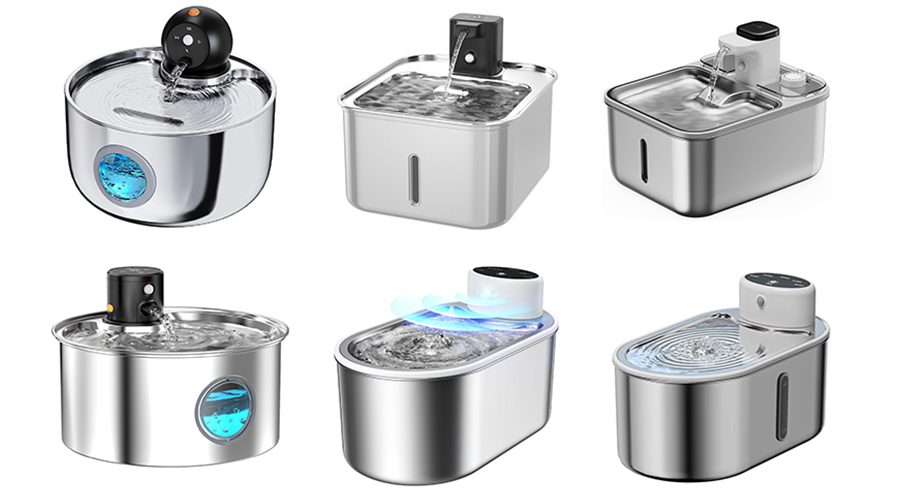
If you’re in the pet product business, you’ve probably noticed cat water fountains moving from specialty shelves to mainstream retail. What started as a niche health product is now a multi-billion-dollar category with no signs of slowing down. But knowing the category is growing isn’t enough — you need to understand *why* it’s growing, *what* buyers are actually looking for, and *where* the real opportunities are.
The market in numbers
The global cat water fountain market was valued at approximately $1.2 billion in 2023 and is projected to reach $2.1 billion by 2030, representing a compound annual growth rate of around 8-10%. That growth is being driven by a combination of health awareness, urbanization, and the premiumization of pet products.
In North America and Europe, cat fountains have moved from Amazon niche to retail shelf in stores like Petco, Chewy, and Zooplus. In Asia-Pacific, the market is expanding even faster as new cat owners in China, Southeast Asia, and the Middle East adopt Western-style pet care habits.
What’s actually driving demand?
Three factors stand out above the rest.
Health messaging is working. The core value proposition — “flowing water encourages cats to drink more” — is backed by veterinary research and resonates with health-conscious pet owners. This isn’t a trend that will fade; it’s rooted in cat biology. Cats have a naturally low thirst drive, and stagnant water in a bowl doesn’t trigger the same drinking behavior as moving water.
Smart features are raising the category’s profile. Modern fountains with sensor modes, timer functions, and energy-saving technology are attracting tech-savvy consumers who expect app control and automation from their pet products. This is pulling cat fountains into the broader smart home ecosystem.
Material upgrades are commanding premium prices. The shift from plastic to stainless steel is one of the most significant trends in the category. Consumers increasingly associate stainless steel with hygiene, durability, and premium quality — and they’re willing to pay 30-50% more for it.
What buyers are looking for
Based on current market data and buyer behavior, here are the features and attributes that matter most:
Quiet operation. Noise level is consistently cited as the #1 purchase driver — and the #1 complaint when a fountain doesn’t deliver. Buyers want pumps that run below 35dB. Manufacturers who can produce ultra-quiet pumps in-house have a clear advantage.
Multi-mode operation. Buyers increasingly expect fountains to offer timer mode, sensor mode, and continuous flow mode in a single unit. This flexibility lets consumers choose based on their cat’s behavior and their own energy preferences.
Easy cleaning. Complex designs with hard-to-reach crevices are a dealbreaker. Buyers want fountains that disassemble quickly and are dishwasher-safe (at least the water tank components).
Durable filtration. Multi-layer filter systems — particularly those with activated carbon and ion exchange — are becoming the standard. Buyers want filters that last 2-4 weeks and actually remove chlorine, debris, and odors.
Capacity options. One size doesn’t fit all. Buyers serving different markets need capacity options ranging from 2L for single-cat households to 5L+ for multi-cat or large-breed homes.
Where the opportunities are for brands
The cat water fountain market is still fragmented. There are a few large players, but the category is wide open for brands that can deliver quality, design, and smart features at competitive price points.
Private label is the fastest entry point. With ODM MOQs as low as 200-500 units, brands can launch a branded fountain line without the cost and timeline of custom tooling. You can add your logo, choose your colors, and develop custom packaging — all on an existing, proven design.
OEM is where differentiation happens. If you have a specific design, feature set, or market requirement in mind, OEM manufacturing lets you build exactly what you envision — from custom tooling and firmware to app integration and packaging.
Consumables are the hidden revenue. Every fountain sold creates a filter replacement customer. Building a filter subscription or reorder program into your product strategy can significantly improve customer lifetime value.
How to evaluate a manufacturer
Not all manufacturers are created equal. When evaluating potential partners for cat water fountain production, prioritize these factors:
- Vertical integration — Does the manufacturer control injection molding, pump production, filter manufacturing, and assembly under one roof? This reduces lead times and quality inconsistencies.
- Quality testing — Look for manufacturers who conduct 100% function testing, AQL inspection, and pump burn-in testing before shipment.
- Certifications — ISO 9001, CE, FCC, RoHS, and UKCA are the baseline for international market access.
- Sample availability — Any reputable manufacturer should provide samples for evaluation before you commit to a production run.
The bottom line
The cat water fountain market is growing because the fundamentals are strong: real health benefits, increasing cat ownership, smart home integration, and consumer willingness to pay for quality. For buyers and brands, the opportunity is clear — but success depends on choosing the right manufacturing partner and understanding what your specific market needs.
Contact HS Smart Pet to discuss how our OEM and ODM fountain solutions can fit your brand strategy.
