
The water pump is the single most important component in a cat water fountain. It determines noise level, water flow, energy consumption, reliability, and ultimately, whether the customer is satisfied or frustrated. Understanding how pumps are manufactured helps buyers evaluate fountain quality and choose the right manufacturing partner.
What makes a fountain pump different
A cat water fountain pump is a small electromagnetic submersible pump. It’s fundamentally different from household water pumps:
Ultra-quiet operation. Cat owners expect pumps to run below 35dB — roughly the volume of a quiet library. This requires precision engineering of the motor, impeller, and magnetic coupling.
Waterproof construction. The pump operates submerged in water, requiring reliable waterproof seals and corrosion-resistant materials.
Low power consumption. Most fountain pumps consume only 1.5-2.5 watts, requiring efficient motor design.
Long lifespan. Consumers expect pumps to last years of continuous operation. Quality pumps are rated for 50,000+ hours of continuous operation.
Compact size. Fountain pumps must fit inside compact pump housings while maintaining performance.
The manufacturing process
Step 1: Motor assembly
The motor is the core of the pump:
Stator assembly — Copper wire is wound onto a laminated steel core to create the electromagnetic coil. The number of turns, wire gauge, and winding pattern determine the motor’s electrical characteristics.
Rotor assembly — A permanent magnet is mounted on a shaft that will drive the impeller. The magnet’s strength and alignment affect pump performance.
Housing assembly — The stator and rotor are assembled into a waterproof housing with precise alignment to ensure efficient electromagnetic coupling.
Step 2: Impeller installation
The impeller is the component that actually moves water:
Impeller design — The shape, number of blades, and diameter of the impeller determine flow rate and pressure. Design optimization balances performance with noise generation.
Magnetic coupling — The impeller is driven by magnetic coupling to the motor — there’s no direct mechanical connection. This eliminates the need for a shaft seal (a common failure point in other pump designs) and reduces noise.
Balancing — The impeller must be precisely balanced to prevent vibration, which causes noise and reduces bearing life.
Step 3: Seal installation
Waterproof sealing is critical for submersible pumps:
Motor housing seals — Prevent water from entering the motor chamber. Typically use precision-fit O-rings or mechanical seals.
Cable entry seal — The power cable entry point must be sealed against water ingress. This is a common failure point in low-quality pumps.
Assembly verification — Sealed assemblies are pressure-tested to verify waterproof integrity.
Step 4: Individual testing
Quality manufacturers test every pump individually — not just samples from a batch:
Flow rate testing — Verifying that the pump delivers the specified water flow (typically 100-300 liters per hour for cat fountains).
Pressure testing — Confirming adequate water pressure for the fountain’s flow modes.
Noise testing — Measuring noise level to verify operation below 35dB.
Power consumption testing — Confirming that the pump operates within specified wattage.
Start-up testing — Verifying that the pump starts reliably in all orientations and water levels.
Step 5: Burn-in testing
Burn-in testing is the most important quality gate for fountain pumps:
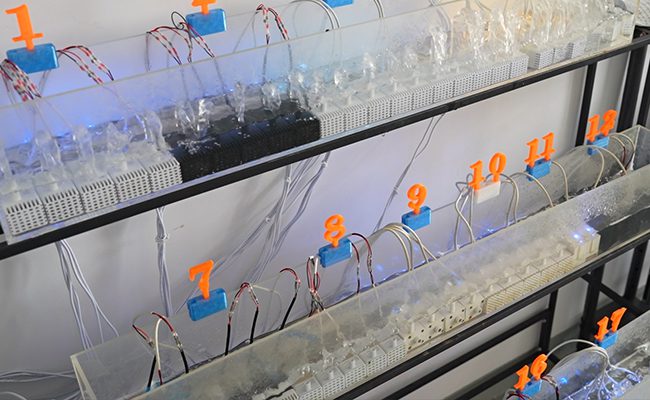
Continuous operation — Pumps run continuously for 48-72 hours (some manufacturers run longer) to identify early failures.
Performance monitoring — During burn-in, flow rate, noise level, and power consumption are monitored for consistency.
Failure identification — Pumps that fail during burn-in are identified and the root cause is analyzed to prevent recurrence.
Burn-in testing is essential because pump failures follow a bathtub curve — most failures occur either very early (manufacturing defects) or very late (wear-out). Burn-in catches the early failures before they reach customers.
Step 6: Final inspection and packaging
Cosmetic inspection — Checking for scratches, defects, or finish inconsistencies.
Functional verification — A final spot-check of flow rate and noise level.
Packaging — Pumps are packaged with protective materials to prevent damage during shipping.
What separates quality pump manufacturing
When evaluating pump manufacturing capability, prioritize these factors:
In-house production. Manufacturers who produce their own pumps — rather than sourcing from third-party suppliers — control quality, reduce lead times, and can customize pump specifications.
100% testing. Every pump should be individually tested, not just sampled from a batch.
Burn-in infrastructure. Dedicated burn-in facilities with monitoring equipment indicate a serious commitment to quality.
Material quality. Impeller magnets, motor windings, and seal materials all affect pump performance and lifespan.
Noise engineering. The difference between a quiet pump and a noisy one often comes down to impeller balance, magnetic coupling precision, and housing design.
Pump specifications to understand
When evaluating fountain pumps, these specifications matter:
- Flow rate (L/h) — How much water the pump moves per hour
- Noise level (dB) — How loud the pump operates
- Power consumption (W) — Energy efficiency
- Lifespan (hours) — Expected operational life
- Head height (m) — Maximum height the pump can push water
- Voltage (V) — Operating voltage (typically 5V USB or 12V DC)
The bottom line
The water pump is the heart of a cat water fountain, and its quality determines the product’s success. Manufacturing quality pumps requires precision assembly, comprehensive testing, and burn-in validation. For buyers, choosing a manufacturer with in-house pump production and 100% testing is one of the most important sourcing decisions.
Learn about HS Smart Pet’s in-house pump manufacturing or explore our fountain product range.
