
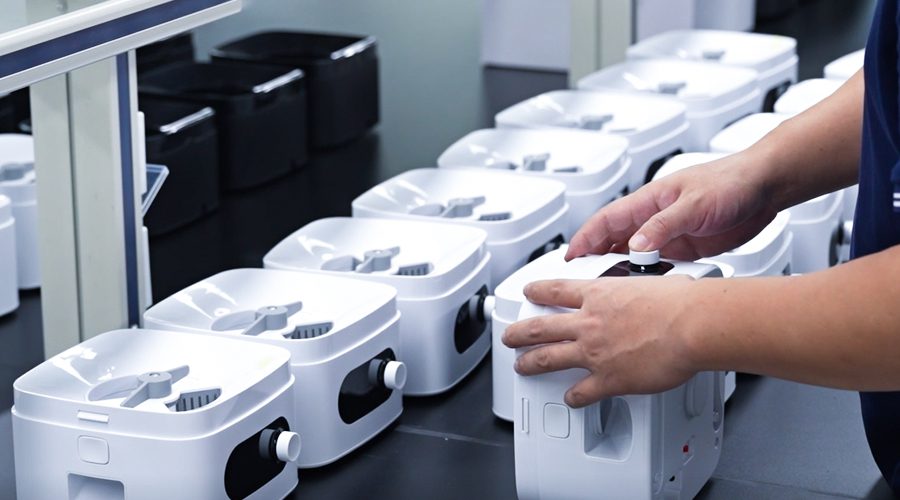
Quality control in cat product manufacturing isn’t a single inspection — it’s a systematic process embedded throughout production. Understanding this process helps buyers evaluate manufacturers and set quality expectations.
The multi-stage QC process
Stage 1: Incoming material inspection
Before production begins, all raw materials are inspected:
Material verification — Confirming that plastics are food-grade, stainless steel is 304 grade, and electronic components meet specifications.
Dimensional checks — Verifying that raw materials meet required tolerances.
Visual inspection — Identifying defects, contamination, or inconsistencies.
Materials that fail inspection are rejected and replaced.
Stage 2: In-process quality checks
During production, quality checks happen continuously:
Injection molding — Checking dimensional accuracy, surface finish, and structural integrity of molded components.
Assembly — Station-by-station quality checks at each assembly step. HS Smart Pet’s assembly lines include quality checks at every station.
Electronics — Testing circuit boards, sensors, and connections before installation.
Stage 3: Component testing
Individual components undergo specific tests:
Pumps — 100% function testing for flow rate, noise level, and power consumption. Burn-in testing runs pumps continuously for 48-72 hours.
Filters — Testing filtration effectiveness, flow rate, and media quality.
Electronics — Testing WiFi connectivity, sensor response, and power management.
Stage 4: Final assembly testing
After all components are assembled into finished products:
Function testing — Every unit is tested for water flow, pump operation, sensor response, and mode switching.
Leak testing — Verifying that all water-contact seals are watertight.
Safety testing — Confirming electrical safety and material compliance.
Cosmetic inspection — Checking for scratches, defects, or finish inconsistencies.
Stage 5: AQL inspection
Before packaging, statistical sampling verifies overall quality:
AQL sampling — Drawing samples from the production run according to AQL standards (typically AQL 2.5 for consumer products).
Defect classification — Categorizing defects as critical (safety), major (function), or minor (cosmetic).
Pass/fail determination — If defect rates exceed AQL limits, the batch is rejected or reworked.
Stage 6: Pre-shipment inspection
The final quality gate before products ship:
Third-party inspection — Independent verification by SGS, Bureau Veritas, or similar organizations.
Documentation review — Verifying that all test reports, certifications, and inspection records are complete.
Packaging verification — Confirming that packaged products are complete and presentable.
Quality management systems
Quality control is supported by systematic management:
ISO 9001:2015 provides the framework for quality management — documenting processes, tracking metrics, and implementing corrective actions.
Non-conformance tracking — Every quality issue is recorded, root causes are analyzed, and corrective actions are implemented.
Continuous improvement — Regular review of quality metrics drives ongoing process improvements.
How to evaluate a manufacturer’s QC
Request quality documentation. Ask for quality manuals, inspection reports, and test records.
Verify testing infrastructure. Visit the factory or request video of testing equipment and procedures.
Check defect rates. Ask about historical defect rates and how issues are resolved.
Review corrective action process. How does the manufacturer handle quality failures? What’s the escalation process?
HS Smart Pet maintains comprehensive quality management under ISO 9001:2015, with multi-stage testing and 100% function testing for all products.
The bottom line
Quality control in cat product manufacturing is a multi-stage process — from incoming materials through final inspection. Manufacturers with systematic QC processes, comprehensive testing, and ISO 9001 certification deliver more consistent quality.
