
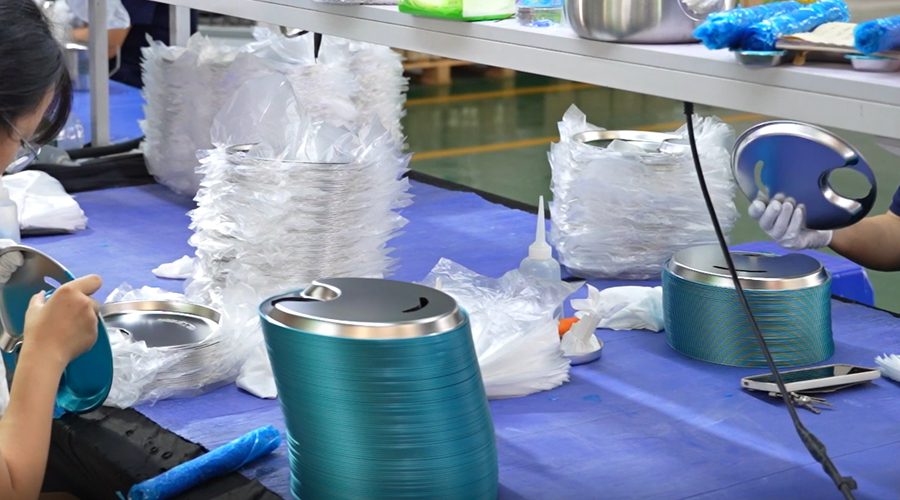
Importing cat products from China offers significant advantages in cost and variety — but quality risks are real. Here’s how to verify quality before committing to a bulk order.
The quality verification process
Step 1: Request samples
Before anything else, get physical samples:
Standard samples. Samples of the manufacturer’s existing products to evaluate baseline quality.
Custom samples. If you’re customizing a product, request samples with your specifications applied.
Production samples. Samples produced from an actual production run (not hand-assembled prototypes).
Evaluate samples for dimensional accuracy, material quality, functional performance, and packaging.
Step 2: Test the samples yourself
Don’t just look at samples — test them:
Fountains: Run the pump for 24+ hours. Check noise level, flow rate, and sensor response. Fill and empty multiple times. Test filter fit and water flow through the filter.
Feeders: Program multiple feeding schedules. Test portion accuracy over 10+ dispensing cycles. Test WiFi connectivity and app responsiveness. Check for jams with different kibble sizes.
All products: Check for sharp edges, material smell, and component fit.
Step 3: Compare multiple manufacturers
Never commit to the first manufacturer you evaluate. Get samples from 3-5 manufacturers and compare:
- Build quality and finish
- Material quality
- Functional performance
- Packaging quality
- Price-to-quality ratio
Step 4: Verify certifications
Request and verify:
- ISO 9001 certificate — Verify authenticity with the certifying body
- CE marking — Request test reports from recognized labs (SGS, TUV, Intertek)
- FCC certification — Verify with FCC database
- RoHS compliance — Request test reports
- Food-contact material tests — FDA and EU 1935/2004 compliance
Step 5: Conduct a factory visit or audit
For significant orders, visit the factory or hire a third-party auditor:
In-person visit lets you see production processes, quality systems, and working conditions firsthand.
Third-party audit (SGS, Bureau Veritas, Intertek) provides an objective, documented assessment.
HS Smart Pet welcomes factory visits and provides virtual tours for international buyers.
Step 6: Pre-shipment inspection
Before your bulk order ships, conduct pre-shipment inspection:
Third-party inspection is the most objective option. An independent inspector visits the factory, draws samples from the production run, and evaluates them against your specifications.
AQL sampling provides a statistical framework for inspection. AQL 2.5 is standard for consumer products.
Step 7: Documentation verification
Ensure all documentation is complete:
- Product specification sheets
- Material certificates
- Test reports (noise, flow rate, electrical safety)
- AQL inspection reports
- Packing lists and commercial invoices
Common quality issues to watch for
Pumps: Noisy operation, weak flow, early failure, water ingress.
Plastic components: Poor fit, flash (excess material), inconsistent color, warping.
Stainless steel: Wrong grade, poor finish, sharp edges, discoloration.
Electronics: WiFi connectivity issues, app instability, firmware bugs.
Packaging: Inadequate protection, missing components, incorrect labels.
Working with quality-focused manufacturers
The best way to ensure quality is to work with manufacturers who prioritize it:
In-house production. Manufacturers who control production under one roof — injection molding, pump production, assembly — can manage quality throughout the process.
100% testing. Manufacturers who test every unit (not just samples) catch defects before shipment.
Quality certifications. ISO 9001, CE, FCC, RoHS demonstrate systematic quality management.
The bottom line
Quality verification before importing requires a systematic approach — samples, testing, certification verification, factory audits, and pre-shipment inspection. Skipping any of these steps increases your risk of receiving defective products.
Contact HS Smart Pet to discuss our quality verification processes and arrange a factory evaluation.
