
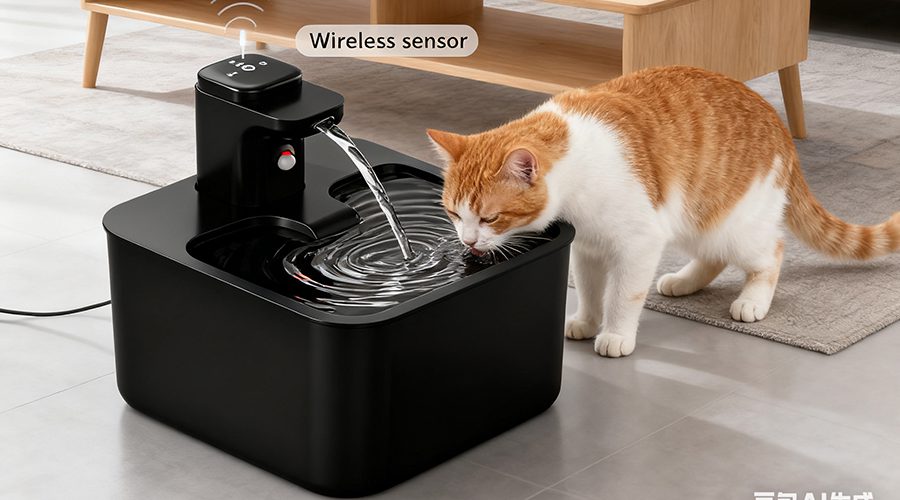
For cross-border pet sellers, pet product companies, and wholesale distributors, cat water fountain refusal and adaptation problems are one of the top sources of after-sales messages, negative feedback, and product returns. Most end-customers think the fountain is defective when their cat avoid it, stop drinking, or act hostile toward the device.
In fact, 99% of cat water fountain refusal cases are caused by feline habits, not product quality. As a professional smart cat water fountain manufacturer, we summarize the three most common cat refusal behaviors, explain the real reasons, and share standardized solutions. This guide helps sellers quickly resolve customer doubts and reduce after-sales pressure.
3 Common Situations Where Cat Refuse Water Fountain
Cat are creatures of strong habit and territorial awareness. Once they form a fixed drinking habit with a static bowl, new flowing water devices will be regarded as unfamiliar foreign objects. Below are the three typical refusal performances and targeted fixes:
| Refusal Type | Cat Specific Behavior | Root Cause | Effective Solution |
|---|---|---|---|
| Hesitant Trial & Avoidance | Approaches the fountain, sniffs, then walks away without drinking | Temporary strangeness to flowing water and machine sound | Turn on sensor mode to attract active exploration; keep old bowl for 1-2 days transition |
| Complete Avoidance | Totally stays away, refuses to approach the fountain | Strong territorial sensitivity, fear of new objects | Enable 24h continuous water flow to build familiarity; maintain stable running state |
| Hostile & Destructive Behavior | Pats, bites, or attempts to knock over the fountain | Defensive instinct against unfamiliar equipment | Use anti-slip stable placement; fix power cord; continue long-term running adaptation |
1. Hesitant Trial and Avoidance (Most Common Scenario)
Most sensitive cat will show a contradictory state: they are curious about the flowing water, but they are not completely relieved of the new fountain. They will approach and observe repeatedly but leave quickly and refuse to drink.
This is the mildest adaptation problem. The solution is to turn on the sensor induction mode. The fountain only flows when the cat is nearby. The dynamic running water simulates natural spring water, which can effectively attract cat interest. Most cat will take the initiative to drink within 1–3 days.
2. Complete Avoidance and No Contact
Some cautious cat have strong resistance to environmental changes. After the owner replaces the water bowl with an electric fountain, the cat will completely ignore the new device and insist on waiting for static water.
The core solution is to activate the 24-hour continuous water outlet mode. Long-term stable water flow and soft running noise eliminate the cat’s sense of strangeness. After continuous exposure, the cat will gradually accept the fountain as a safe daily drinking tool.
3. Hostile Reaction and Destructive Behavior
A small number of territorial cat regard the new fountain as an intruder. They will slap the body, bite the edge, or attack the power cord. Many users mistakenly believe the product is unsafe or defective.
This is purely a feline instinct reaction. Our wholesale fountain adopt overall anti-slip and anti-tilt structure, which can effectively resist cat impact. Sellers only need to remind end users to fix the power cord to avoid biting damage. No quality risk exists.
FAQ: Cat Water Fountain Refusal & Adaptation Troubleshooting
Q1: My cat never drinks from the new fountain. Should I keep the old water bowl?
A1: Do not permanently retain the old bowl. Long-term dual water sources will make cat rely on traditional bowls and refuse adaptation. You can keep both for 1–2 days for transition. After the cat begins to explore the fountain, remove the old static bowl in time.
Q2: Is my water fountain broken if my cat refuses to use it?
A2: Almost never. Cat refusal is an adaptation problem, not a product failure. If the machine runs normally with water flowing steadily, the product works fine. All adaptation issues can be solved through mode adjustment and transitional guidance.
Q3: How long does it take for a cat to start using a new water fountain?
A3: Most cat adapt within 1–3 days. A few sensitive cat need 3–5 days. With correct mode settings, the success rate of active drinking adaptation is over 98%.
Q4: Will continuous mode cause high power consumption?
A4: No. Our pet fountain adopt low-power silent pumps. 24-hour operation consumes negligible power and meets international energy-saving standards, bringing no extra cost to end users.
Q5: My cat only licks flowing water but does not drink tank water. Is this normal?
A5: Completely normal. Cat are naturally attracted to running water. This behavior proves the fountain’s core advantage of encouraging water intake. As long as the cat drinks enough water daily, no intervention is needed.
Q6: The fountain makes slight noise, making my cat scared. How to fix it?
A6: Put the fountain in a fixed quiet position and keep it running continuously for 1–2 days. Cat will gradually adapt to the low running noise. The noise of our products is controlled below 30dB, which belongs to ultra-quiet household level.
Q7: Can I use tap water directly in the cat fountain?
A7: It is not recommended. Tap water contains chlorine and fine impurities, which may affect water taste and make cat unwilling to drink. Purified water or cool boiled water is better for cat acceptance and filter service life. We provide supporting replacement filters for long-term use.
Q8: Will cat adaptation problems lead to product returns?
A8: The actual return rate caused by adaptation problems is lower than 1%. Most users can successfully guide their cat to adapt after learning professional methods, bringing stable positive reviews for sellers.
Q9: Why does my cat drink less water after replacing the fountain?
A9: It is a short-term minor stress response during environmental replacement. It will recover completely within 3 days. After full adaptation, running water will effectively increase the cat’s daily water intake and improve urinary health.
Q10: Do you support customized water fountain for different market demands?
A10: Yes. As a reliable pet smart device factory, we support wholesale, OEM, ODM and private label customization. We optimize product modes, noise control and anti-bite design according to global market feedback, helping sellers reduce after-sales risks. Feel free to contact us for cooperation.
Conclusion
Cat refusing water fountain is a common behavioral adaptation problem, not a product defect. With reasonable mode switching and transitional guidance, almost all cat can accept smart flowing water fountain. Our factory’s pet water fountain are optimized for cat habits, with low after-sales rate and high user satisfaction, which are stable and profitable stocking products for global pet sellers and brands.
