
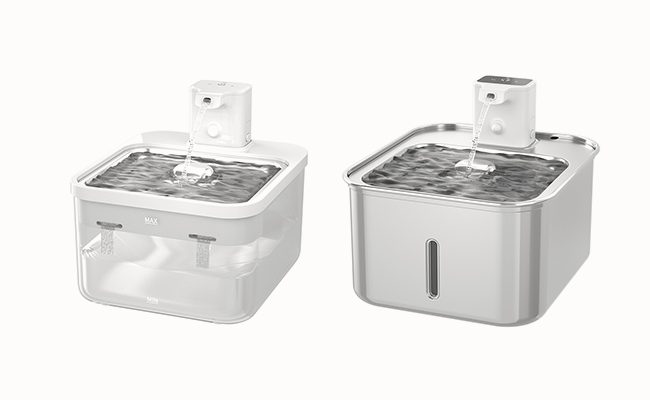
Stainless steel has become the premium material of choice for cat water fountains, commanding 30-50% higher prices than plastic alternatives. But manufacturing stainless steel components is fundamentally different from injection molding plastic — and the quality of the manufacturing process directly determines whether the finished product meets the “premium” expectation.
Here’s how stainless steel cat water fountain components are manufactured, and what buyers should know about the process.
Why stainless steel is harder to manufacture
Stainless steel presents several manufacturing challenges that plastic doesn’t:
Higher material cost. 304 stainless steel costs significantly more than plastic resins, making material waste more costly.
More complex forming. Steel requires die-casting, stamping, or deep drawing — processes that involve higher forces, more complex tooling, and more wear on equipment.
Surface finishing demands. Consumers expect stainless steel products to have a smooth, attractive finish — typically mirror polish or brushed. Achieving this requires specialized polishing equipment and skilled operators.
Corrosion resistance requirements. Stainless steel’s corrosion resistance is one of its key benefits, but it must be properly processed to maintain this property. Improper heat treatment or contaminated tooling can compromise corrosion resistance.
The manufacturing process
Step 1: Material selection and preparation
The foundation of a quality stainless steel fountain is the right material grade:
304 stainless steel is the standard for food-contact applications. It offers excellent corrosion resistance, is easy to clean, and meets food safety standards for most international markets.
Material comes in sheets or coils of specific thickness (typically 0.5mm-2.0mm for fountain components). Before processing, material is inspected for surface defects, thickness consistency, and material certification.
Step 2: Cutting and blanking
Stainless steel sheets are cut to the required sizes for each component:
Laser cutting provides precise, clean edges for complex shapes. It’s the preferred method for high-quality production.
Mechanical blanking uses dies to punch out component shapes from sheet metal. This is faster for high-volume production of simpler shapes.
Step 3: Forming
The cut blanks are formed into their final shapes:
Deep drawing is the primary process for creating bowl-shaped components (the water bowl is the most common stainless steel component in fountains). A punch forces the blank into a die cavity, stretching the metal into a three-dimensional shape.
Stamping creates flanges, rims, and other features that require bending or folding.
CNC forming handles complex geometries that can’t be achieved with simple deep drawing or stamping.
The quality of forming depends on die design, material properties, and process control. Proper die design prevents defects like wrinkling, tearing, and uneven wall thickness.
Step 4: Trimming and edge treatment
After forming, excess material is trimmed and edges are treated:
Trimming removes excess material from the edges of formed components.
Deburring removes sharp edges and burrs left by cutting and forming processes.
Edge rounding creates smooth, safe edges — essential for products that will be handled regularly and cleaned frequently.
Step 5: Surface finishing
Surface finishing is what gives stainless steel its premium appearance:
Mirror polishing creates a highly reflective, smooth surface. This is the most common finish for premium fountain bowls. The process involves progressive grinding and polishing with increasingly fine abrasives.
Brushed finishing creates a satin, directional finish that hides fingerprints and minor scratches. It’s common for components that don’t need mirror reflectivity.
Passivation is a chemical treatment that enhances the natural corrosion resistance of stainless steel by removing free iron from the surface and promoting the formation of the protective chromium oxide layer.
Step 6: Quality inspection
Stainless steel components undergo rigorous quality inspection:
- Dimensional verification — Ensuring components meet specified dimensions and tolerances
- Surface finish inspection — Checking for scratches, pits, discoloration, and finish consistency
- Material verification — Confirming material grade through XRF testing or material certificates
- Edge quality — Verifying smooth, safe edges with no sharp points
- Fit testing — Confirming that stainless steel components fit properly with plastic components
Step 7: Cleaning and passivation
Before assembly, stainless steel components are thoroughly cleaned:
- Ultrasonic cleaning removes oils, particles, and contaminants from the forming and finishing processes
- Passivation treatment enhances corrosion resistance
- Final inspection confirms cleanliness and surface quality
What separates quality stainless steel manufacturing
When evaluating a manufacturer’s stainless steel capability, look for:
In-house capability. Manufacturers who produce stainless steel components in-house — rather than outsourcing — can control quality, reduce lead times, and offer more competitive pricing.
Material traceability. Quality manufacturers maintain documentation proving material grade and origin. This is essential for certification and compliance.
Equipment investment. Proper deep-drawing presses, CNC equipment, and polishing stations require significant capital investment. Factories with modern equipment produce more consistent results.
Skilled operators. Stainless steel forming and finishing require experienced operators who can identify and correct quality issues in real time.
Surface finish standards. Mirror polish should be consistent across the entire surface, with no visible scratches, pits, or discoloration. The finish should feel smooth to the touch.
How stainless steel affects pricing
The manufacturing complexity of stainless steel directly affects product pricing:
Material cost is higher than plastic, typically adding $1-3 to component cost depending on size and thickness.
Tooling cost is higher due to the forces involved in forming steel versus plastic.
Finishing cost is significant — mirror polishing is labor-intensive and requires specialized equipment.
Total cost premium typically adds $3-8 to the finished product compared to an equivalent plastic component. This premium is reflected in the 30-50% higher retail prices that stainless steel fountains command.
The bottom line
Stainless steel cat water fountain manufacturing involves specialized processes — from material selection through deep drawing, surface finishing, and quality inspection — that are fundamentally different from plastic injection molding. The quality of these processes directly determines whether the finished product meets the premium expectations that justify higher prices.
See HS Smart Pet’s stainless steel manufacturing capabilities or request a quote for stainless steel cat product components.
