
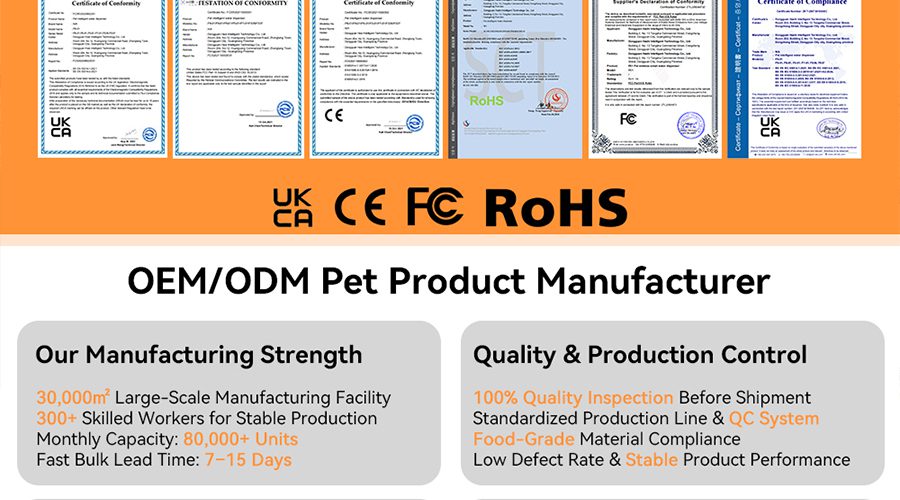
Selling cat water fountains internationally requires meeting different certification standards in different markets. Understanding these requirements before sourcing prevents costly compliance issues after import.
Certification requirements by market
United States
FCC certification — Required for products with electronic components (WiFi modules, control boards, LED indicators). FCC Part 15 covers unintentional radiators (electronic devices that emit electromagnetic energy).
CPSC compliance — Consumer Product Safety Commission requirements for product safety.
UL/ETL listing — Not always legally required but strongly recommended. Many retailers require UL or ETL listing for electrical products.
California Prop 65 — Warning requirements for products containing chemicals known to cause cancer or reproductive harm.
FDA compliance — For products with food-contact materials, FDA food-contact material regulations apply.
European Union
CE marking — Mandatory for products sold in the EU. Covers electrical safety, electromagnetic compatibility, and other requirements.
RoHS compliance — Restriction of Hazardous Substances. Limits the use of lead, mercury, cadmium, and other hazardous materials.
REACH regulation — Registration, Evaluation, Authorization, and Restriction of Chemicals. Covers chemical safety requirements.
WEEE directive — Waste Electrical and Electronic Equipment. Requires proper disposal/recycling provisions.
United Kingdom
UKCA marking — UK Conformity Assessment. Post-Brexit replacement for CE marking in the UK market.
Other markets
RCM marking (Australia/New Zealand) — Regulatory Compliance Mark for electrical products.
PSE mark (Japan) — Product Safety Electrical Appliance and Material.
KC mark (Korea) — Korea Certification for electrical and electronic products.
Food-contact material certifications
For products that contact water or food:
FDA compliance (US) — Food-contact material requirements under FDA regulations.
EU 1935/2004 — European regulation on materials intended to come into contact with food.
LFGB (Germany) — German food safety standard (stricter than general EU requirements).
Factory certifications
ISO 9001:2015 — Quality management system certification. Demonstrates systematic quality management processes.
ISO 14001 — Environmental management system certification. Demonstrates environmental responsibility.
BSCI/SA8000 — Social compliance audits covering labor conditions.
How to verify certifications
Request copies of all certification documents from your manufacturer.
Verify with certifying bodies — Check certificate numbers with the issuing organization (SGS, TUV, Intertek, etc.).
Check validity dates — Certifications expire and must be renewed.
Confirm scope — Ensure the certification covers the specific product you’re purchasing.
What HS Smart Pet offers
HS Smart Pet holds:
- ISO 9001:2015 quality management certification
- CE marking for European markets
- FCC certification for US markets
- RoHS compliance for hazardous substance restrictions
- UKCA marking for UK markets
- SGS third-party verification
We also support UL/ETL testing and food-contact material compliance (FDA / EU 1935/2004) on request.
The bottom line
Certification requirements vary by market, but CE, FCC, RoHS, and UKCA cover the majority of international markets. Working with a manufacturer who already holds these certifications simplifies your import process significantly.
Contact HS Smart Pet to discuss certification requirements for your target markets.
