
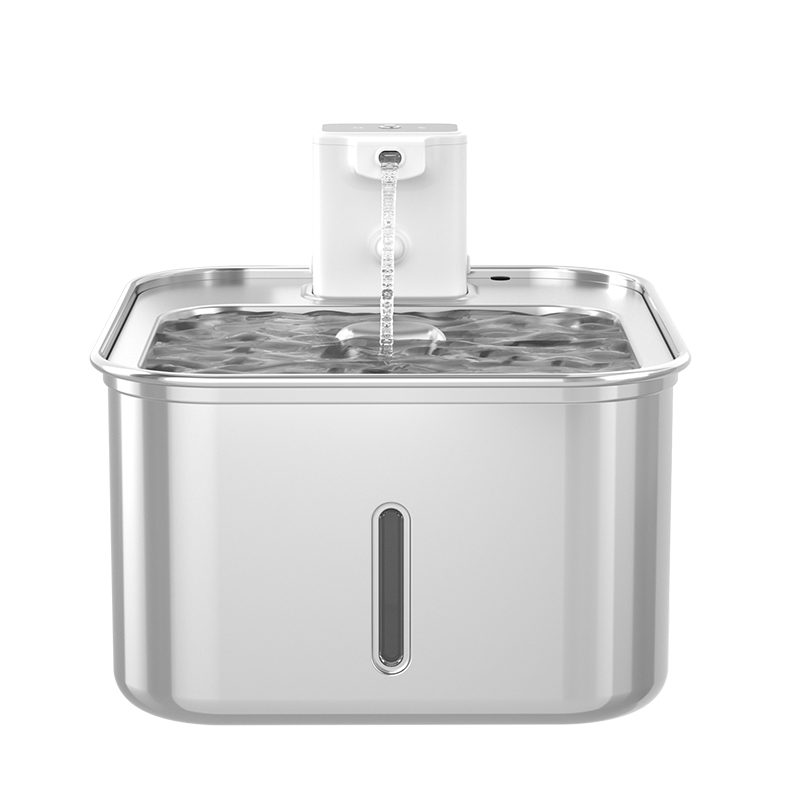
A cordless (battery) cat water fountain unlocks placement a wired model never could: balconies, enclosed pens, bathroom shelves, office corners — anywhere your cat actually spends time but has no outlet. Before buying, verify four things: a detachable battery, 2.5L+ capacity, tool-free disassembly, and realistic runtime per charge (5-15 days depending on mode; induction mode roughly triples it). Keep the fountain away from litter boxes, food bowls, and direct sun — cordless frees you from outlets, not from cat logic.
Walk into any pet store and every wired water fountain comes with the same invisible instruction: place within arm’s reach of an outlet.
That single constraint quietly shapes your entire home. The fountain lives where the power is — kitchen counter, living room corner — not where your cat actually drinks, sleeps, or hides. Cordless fountains delete that rule. And once you start planning placements without a cable, the list gets interesting.
How we put this guide together
This guide combines three inputs. First, aggregated owner reports from Reddit (r/cats, r/CatAdvice, r/catcare) and Amazon verified reviews on battery-powered fountains — specifically where owners placed them, what broke, and how runtime compared to the box claims. Second, product-level evaluation of the wireless fountain configurations we manufacture, including battery chemistry, pump draw by mode, and sealing design. Third, basic placement principles from cat behavior guidance: water source separation from litter and food, traffic patterns, and territory mapping.
Where manufacturer claims and owner-reported experience diverged, owner reports were weighted more heavily. Marketing runtime figures assume ideal lab conditions; real households leave fountains on continuous mode and forget to charge.
Five places you’d never put a fountain (until it’s cordless)
1. The balcony
A shaded balcony in summer is where cats naturally gravitate — warm air, birds, a patch of sun. It’s also where owners never put water because “there’s no outlet out there.” A battery-powered fountain changes the economics of dehydration: water goes where the cat goes, and the cat drinks more because drinking becomes part of its territory routine. In hot climates, this alone justifies the switch — outdoor-access cats on balconies dehydrate faster than owners realize.
2. Inside a large crate or pen
Multi-cat homes, post-surgery recovery, newborn kittens — pens need water inside them, and running an extension cord into an enclosed space is a hazard nobody should accept. A cordless fountain sits safely in the middle of the pen with zero cable near paws or teeth. Foster homes and breeders are, quietly, one of the biggest battery-fountain adopter groups for exactly this reason.
3. The bathroom shelf
Quiet, cool, low-traffic — bathrooms are underrated hydration spots, especially for shy cats that avoid the busy kitchen. Owners skip it because the nearest outlet is behind the washing machine. With a rechargeable unit, the shelf itself becomes the station. One owner report pattern worth noting: shy cats in multi-cat households drink significantly more from a second fountain placed in a low-traffic room.
4. The office corner
Remote workers increasingly set up “cat zones” beside their desks. A cordless fountain lets the cat drink beside you without a cable snacking across the floor — the same reason people buy wireless chargers for phones. It also keeps the workspace visually clean, which matters more than pet guides admit: owners who like how a setup looks maintain it more consistently.
5. Anywhere the cat has already decided
Every cat owner knows the moment: the cat starts drinking from a glass on the coffee table, the water pitcher, the shower drip. Behaviorists read this as “the water I chose beats the water you gave me.” Cordless lets you respond to that signal by moving the real fountain to the chosen spot — no furniture rearranging, no outlet map.
| Placement | Why wired fails here | What to watch with a battery unit |
|---|---|---|
| Balcony / semi-outdoor | No outlet; cable through door is a trip hazard | Direct sun heats water and drains battery faster — use shade + induction mode |
| Closed pen or crate | Extension cord inside an enclosure is unsafe | Smaller capacity limits interval between checks |
| Bathroom shelf | Outlet occupied or too far | Humidity is fine; just keep the charging port dry |
| Office corner | Cable across walking path | Easy to top off daily — the ideal low-effort spot |
| Cat-chosen spot | Often no outlet at all | Validate the spot for a week before committing the fountain |
What to check before buying a cordless fountain
Wireless is the right idea executed badly by plenty of manufacturers. The difference between a good cordless fountain and a frustrating one is usually four details:
- Battery you can actually charge. A detachable battery pack, not a sealed internal cell. Charging the whole fountain at the sink means hours without water — the exact failure mode that sends owners back to a bowl. Removable packs let you rotate: one on the fountain, one on the charger.
- Capacity that matches the freedom promise. 2.5-3L covers 3-5 days for multi-pet homes. A 1L “cute” tank makes “place anywhere” meaningless, because you end up visiting every spot daily anyway.
- Tool-free disassembly. Pump, battery, and tank should separate by hand. If cleaning requires a screwdriver, the fountain gets cleaned rarely — and rarely-cleaned fountains get slimy, regardless of how wireless they are.
- Sensible, published runtime. Not “up to 30 days” in a lab. Look for mode-specific figures: continuous flow drains fastest; intermittent (16s every 15 min) roughly halves draw; induction mode (flows only when the cat approaches) can triple it.
| Mode | Water behavior | Typical runtime effect | Best for |
|---|---|---|---|
| Continuous | Always flowing when plugged into battery | Shortest — baseline figure | Very hot climates, cats that only drink from running water |
| Intermittent | 16 seconds every 15 minutes | Roughly 2x baseline | General use, predictable water freshness |
| Induction (motion) | Flows when cat approaches | Up to ~3x baseline | Weekend placements, balconies, multi-spot setups |
Deployment protocol: the first 7 days
Placement freedom comes with one caveat: cats are conservative about change. Run the first week like this:
- Deep-clean the fountain before first fill. Factory residue and stale water from the box are the two most common “my cat won’t touch it” causes. Full disassembly, mild unscented soap, rinse until no scent remains.
- Charge to 100% and confirm the runtime figure yourself. Note the charge date. If claimed runtime and your observed runtime diverge badly, you’ve found a spec you can’t trust — decide early whether to keep the unit.
- Start in the current water location. Don’t change position and product in the same week. Place the new fountain where the old bowl was; let the cat accept the object first.
- Add water from the old bowl. Scent transfer sounds unscientific and works reliably — it tells the cat the new water source carries familiar water.
- Move it after day 5. Once drinking is established, relocate to the target spot (balcony, office, pen). After acceptance, one relocation rarely resets the habit.
- Set mode to induction during work hours. Baseline battery stretches immediately; switch modes only when you observe the cat hesitating at the sensor zone.
- Log the first charge cycle. Date in, date out, mode. This single habit tells you whether this fountain’s battery is honest — information every later purchase benefits from.
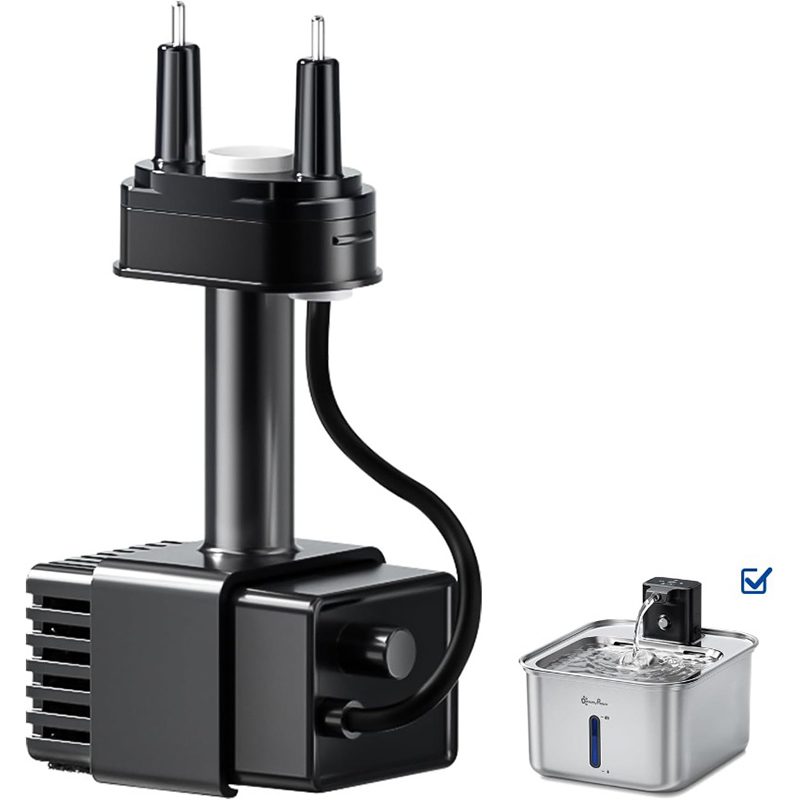
From the factory side, “cordless” is two separate design problems that cheap products combine badly. The battery problem: capacity in mAh means little without the pump’s actual draw per mode — we specify runtime as measured hours per mode, not a single marketing number. The water problem: the charging port and battery compartment are the only places a sealed fountain can leak or ingest moisture. That’s why our wireless line uses a fully detachable battery module and pump-to-tank isolation (the electrical path never shares the wet compartment). When buyers evaluate samples, the two fastest quality checks are: how many seconds it takes to remove the battery without tools, and whether the pump housing survives a full-tower submersion test. Both are specification decisions made during tooling, not features you can retrofit later. Our ODM program documents both in the DFM report before sampling.
Cordless vs. wired: the honest comparison
| Factor | Cordless (battery) | Wired |
|---|---|---|
| Placement freedom | Unlimited — any room, any surface | Within cable reach of an outlet |
| Power reliability | Depends on charge discipline; outage-proof | Continuous; dies in a blackout |
| Safety optics | No cable near water or teeth | Cable at water station is a stated owner concern |
| Maintenance load | Two consumables: filter + charge cycle | Filter only |
| Upfront cost | Higher (battery module + charging circuit) | Lower |
| Best fit | No-outlet spots, multi-room setups, travel households | Single permanent station near power |
Honest take: a wired fountain at a permanent kitchen station is still fine. Cordless wins wherever the constraint is real — which, in most homes surveyed, is at least one room.
Frequently Asked Questions (FAQ)
How long does a cordless cat water fountain battery last?
Quality models run 5-15 days per charge depending on mode. Induction mode can roughly triple runtime versus continuous flow. Demand mode-specific figures, not a single “up to” number — and prefer designs with a detachable battery so you can rotate packs instead of waiting through a dry window.
Is a wireless fountain safe to leave unattended while traveling?
Yes, if capacity and charge cover the trip — that’s the core use case. Set intermittent or induction mode before leaving, and ask a neighbor to check the level on day 4+ for 2.5-3L models. Test the full runtime at home before trusting it on a trip.
Can I use a cordless fountain outdoors on a balcony?
Semi-outdoor yes, direct rain no. Place it in shade — sun heats the water, accelerates bacterial growth, and drains the battery faster. Check that the charging port cover seats fully; humidity is fine, standing water on the port is not.
Will the pump stop working when the battery runs low?
Quality designs either run until a safe cutoff or give a low-battery indication first. The failure pattern to avoid is a pump that runs dry and burns its seal — confirm low-water protection is built in, battery or not.
Do cordless fountains use stainless steel bowls too?
Yes. Hybrid models pair a rechargeable base with a 304 stainless steel drinking basin, giving placement freedom and the hygiene benefits of steel in one unit — the configuration we recommend for multi-cat homes.
Is induction mode safe for cats?
Yes — the sensor triggers flow on approach, which is exactly the natural behavior (cat comes, water runs). Watch for hesitant cats at first: some need a few days to associate approach with flow. Intermittent mode is the safe fallback during that week.
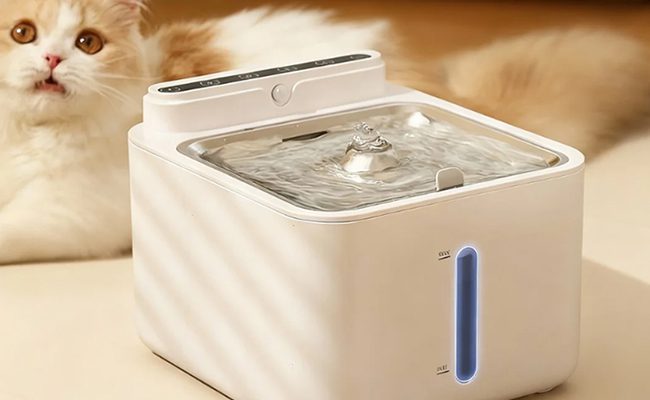
Want OEM cordless models with your battery branding and runtime spec, or a sample to run your own 7-day placement test? Contact HS Smart Pet — factory-direct from Huizhou, 100,000+ units monthly capacity, FBA-ready packaging on request.
