
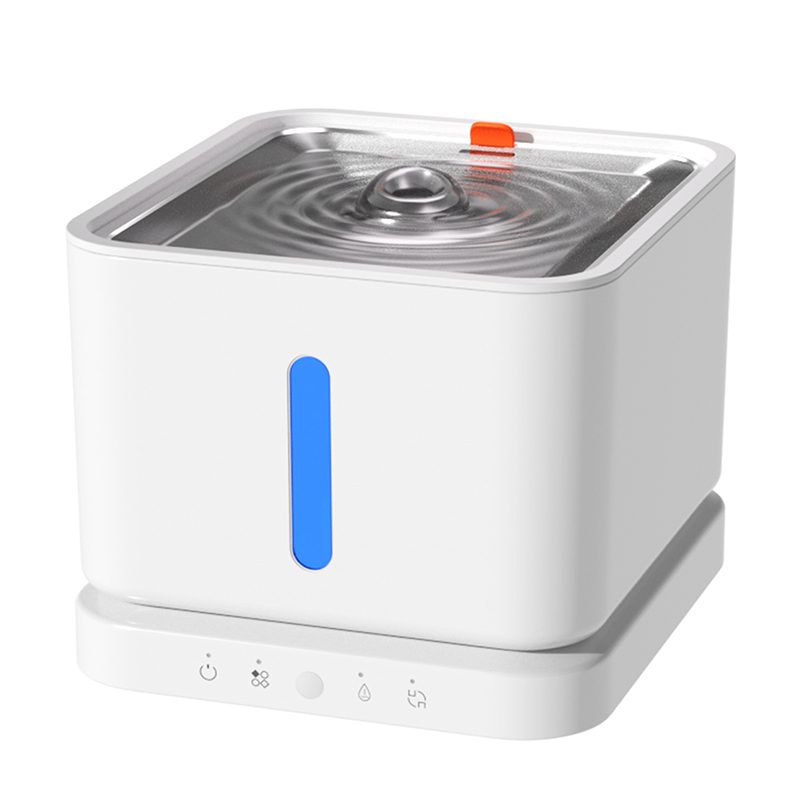
Cats genuinely drink less when water is cold, and winter intake drops raise urinary and kidney risk. The practical fix set: hold water at a pet-comfortable 25-30°C (77-86°F) with a thermostat-controlled heated fountain, add warm water to wet food, place a second bowl away from food and litter, and clean on schedule regardless of season. Never wait out straining, crying, or bloody urine — those are same-day vet emergencies.
Track your cat’s water bowl through January and you’ll notice something odd: the level barely moves. Not because your cat vanished — because cold water makes fountains and bowls genuinely less appealing to drink from.
It sounds trivial. It’s not. Winter dehydration is a quiet contributor to the urinary and kidney issues vets see spike after the cold months set in.
How we put this guide together
This guide draws on three sources. First, veterinary and feline husbandry literature on drinking behavior, temperature preference, and the well-documented link between chronic low intake and urinary tract disease. Second, aggregated owner reports from Reddit (r/cats, r/CatAdvice, r/FelineHealth) and Amazon verified reviews of heated fountain models — what changed after switching, and what owners wish they’d known. Third, product engineering on the heating side: thermostat control bands, wattage under steady load, and the safety design points that separate a reliable heated fountain from a risky one.
Where marketing claims and owner reports diverged, owner reports were weighted more heavily. Winter hydration is a behavior problem first and a hardware problem second — the guide is ordered that way.
Why cats avoid cold water
Two mechanisms stack up in winter:
Temperature sensitivity. A cat’s mouth is tuned to prefer water close to body-adjacent temperatures. Drinking-behavior studies and consistent owner reports show preference clustering around room temperature, with cold water actively avoided by a meaningful share of cats — especially seniors, whose thirst threshold is already blunter.
The seasonal intake drop. Cats drink less in cold weather for reasons beyond preference: wet food intake often rises (cold makes kibble less appealing, and wet food contains ~70-80% water, which partially masks the shortfall), activity patterns shift, and the general “huddle and conserve” instinct reduces trip frequency to the water station. Combine a lower baseline with actively avoided water temperature, and total sip count drops fast.
Watch for the compensation behaviors: cats eating more wet food (a partial hydration substitute), visiting the tap more often, or simply drinking less while acting perfectly normal otherwise. The bowl doesn’t lie — volume over 48 hours is the honest metric.
Why “just drink more water” advice fails
Chronic low intake concentrates urine. Over months, that raises the risk of crystal formation, urinary blockages (an emergency, especially in male cats — a blocked urethra becomes life-threatening within 24-48 hours), and kidney strain that accumulates silently for years.
The math is unglamorous: a cat that drinks 30% less water in winter is a cat whose kidneys work harder every day until spring. And unlike many feline health issues, this one has an environmental fix that costs less than a single emergency vet visit.
The 25-30°C fix: how heated fountains work
Heated cat water fountains hold water in a narrow band — typically 25-30°C (77-86°F). Warm enough that the water reads as “fresh, not frozen” to a cat’s mouth. Cool enough to avoid scalding risk and to keep bacterial growth no worse than room temperature.
The engineering differences that matter when comparing units:
| Feature | What to look for | Why it matters |
|---|---|---|
| Control method | Thermostat with a fixed comfort band, not a bare heating element | Holds 25-30°C instead of climbing — consistency is the whole point |
| Pump-heater isolation | Wireless pump or full water-electricity separation | The heating circuit and the wet compartment must never share a housing |
| Steady power draw | Published wattage at holding temperature (typically 5-15W) | Runs 24/7 all winter — running cost should be cents per day |
| Safety cutoffs | Dry-boil protection + overheat cutoff | Low water + heat is the failure combination that needs a hard stop |
| Capacity | 2.5-3L for multi-day supply | Warm water evaporates slightly faster; larger tank buffers that |
What a quality heated fountain must get right
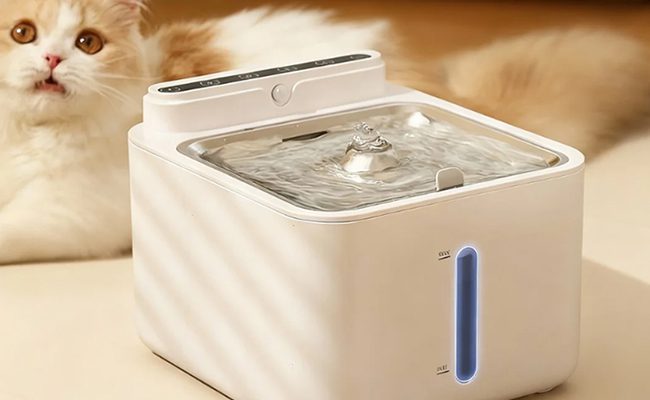
Our heated platform (constant-temperature control, 25-30°C band, 3L capacity, tool-free pump removal) was designed around this winter scenario. The checklist generalizes to any brand:
- Thermostat, not element. The unit must regulate to a band, not just “get warm.” Ask suppliers for the control method and hysteresis — a unit that cycles 20-38°C fails both comfort and safety.
- Water-electricity separation. Wireless pump designs remove the leakage risk that becomes more important once a heating element is in the base. This is non-negotiable in our build, and buyers should treat it that way.
- Dry-boil protection as standard. Heat + low water is the exact failure state. A float or thermal cutoff that kills power before the heater runs dry is the one safety feature to verify on samples personally.
- Full disassembly survives the added complexity. Heaters tempt manufacturers into sealed assemblies. If the pump can’t still come apart by hand for cleaning, the hygiene design has regressed — test teardown on the sample, not the datasheet.
Adding a heater to a fountain is easy; adding one that survives a bathroom in February is a component-specification problem. The three decisions that determine whether a heated unit is still working in year two: the thermostat’s calibration tolerance (cheap bimetallic parts drift), the potting of the heating element against moisture ingress, and whether the low-water cutoff is a physical float or a software guess. We test heated units with 500+ thermal cycles and a dry-run cutoff test before they leave the line — because the failure mode (heater runs with no water) is the one that makes recall headlines. For brands evaluating private label heated models, ask your supplier for the cycle test report, not the feature list.
Three quick winter hydration boosts (no new gadget required)
Even with a heated fountain, three habits compound the effect:
- Add a spoon of warm water to wet food. Raises total intake without your cat noticing — the simplest intervention in this entire guide.
- Widen the water map. A second bowl away from food and litter recovers the “forgot to drink” moments. Winter cats drink in short, scattered sessions, not one dedicated visit.
- Clean more, not less. Cold water grows biofilm slower, so owners slack off — but a grimy fountain rim in winter is one more reason to walk past the water. Keep the weekly disassembly schedule.
| Winter adjustment | Single cat | Multi-cat home |
|---|---|---|
| Full water change | Every 2-3 days | Every 1-2 days |
| Basin wash | Weekly | Weekly (twice if visible film) |
| Filter replacement | Every 3-4 weeks | Every 2-3 weeks |
| Heater check | Feel the water temperature weekly — if it has gone cold, the cutoff may have tripped; check water level first | |
When winter dehydration needs a vet
Reduced drinking plus any of these — straining in the litter box, crying while urinating, bloody urine, vomiting, sudden lethargy — means call the vet today, not tomorrow. Urinary blockages escalate within hours and are disproportionately fatal in male cats. No home fix, warm or cold, substitutes for that call.
Scheduled-checkup territory: any cat with a history of crystals or kidney values should have a winter recheck — intake changes you can see are the tip of what urine tests can measure.
Frequently Asked Questions (FAQ)
Is it safe to leave a heated fountain on 24/7?
Yes — that’s the design intent. Quality units run thermostat-controlled at low wattage (typically 5-15W holding). Look for overheat cutoff and dry-boil protection as standard. Cost is negligible: continuous 10W for a month is a few kilowatt-hours.
Do cats actually drink more from warm water?
Observational data and owner reports consistently show increased intake with room-temperature-to-warm water versus cold, particularly in winter and for senior cats. It’s not a cure-all, but it removes one reason to avoid the bowl — and it’s the cheapest environmental variable to control.
Can I just microwave the water instead?
You can warm the bowl, but temperature drops below preference range within 30-60 minutes — and cats drink on their own schedule, not yours. A thermostat holding 25-30°C solves the consistency problem manual warming can’t. Never microwave with the cat present; localized hot spots are a burn risk.
What temperature is too warm for a cat fountain?
Above ~35°C (95°F) the water feels stale to cats and bacterial growth accelerates. The 25-30°C band is the accepted comfort window. Units without a visible thermostat reading should be verified with a kitchen thermometer on arrival.
Do heated fountains use more electricity than expected?
At 5-15W holding with thermostat cycling, real-world winter cost is typically under $3-5 per month in most regions. Ask for steady-state wattage (not peak) — that’s the number on the bill.
Is a heated fountain only useful in winter?
Cold-climate homes year-round, air-conditioned rooms in summer, and senior cats everywhere benefit from tempered water. For product lines, it’s a Q4/Q1 merchandising story with genuine off-season utility for northern markets.
Planning a winter product launch, or need heated fountain specs and sample units? Request the specification sheet or explore ODM development — we handle thermostat calibration, cycle testing, safety certification, and private label packaging for cold-market launches.
