
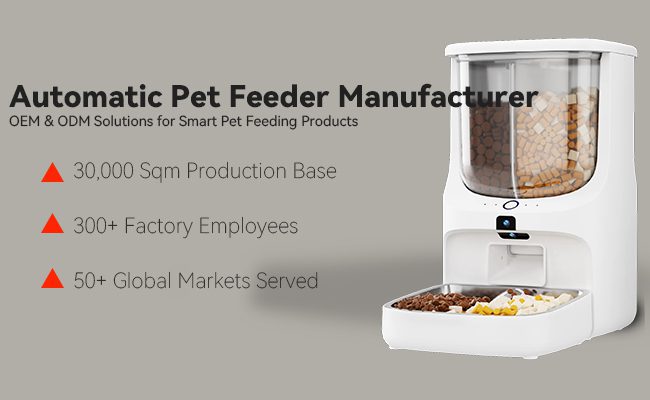
The automatic pet feeder market is growing rapidly as pet owners seek convenient, reliable ways to feed their animals on schedule — whether they are at work, traveling, or simply want to maintain consistent meal routines. For pet brands, retailers, and entrepreneurs, this demand represents a significant business opportunity. But bringing a competitive automatic pet feeder to market requires more than a good idea. It requires a manufacturing partner with the engineering capability, production scale, quality systems, and customization flexibility to turn your product vision into a commercially viable reality. This guide covers everything you need to know about automatic pet feeder OEM and ODM services, from product types and features to manufacturing processes, certifications, and go-to-market strategies.
Understanding OEM and ODM in the Pet Feeder Context
Before diving into product specifics, it is important to understand the two primary partnership models available when working with a pet feeder manufacturer:
OEM (Original Equipment Manufacturer)
In an OEM arrangement, you provide the product design, specifications, and branding. The manufacturer produces the feeder according to your exact requirements. You own the design, and the manufacturer acts as your production arm. This model is ideal if you have an in-house product design team or have already completed the engineering work and need a factory to manufacture at scale.
ODM (Original Design Manufacturer)
In an ODM arrangement, the manufacturer provides an existing product design or platform that you can customize with your branding, feature modifications, and aesthetic changes. The manufacturer handles the engineering and design work, and you bring the market knowledge, distribution channels, and brand identity. This model is ideal if you want to enter the market quickly without investing in product development from scratch.
| Factor | OEM | ODM |
|---|---|---|
| Design ownership | You own the product design and intellectual property. | The manufacturer owns the base design; you own your branding and custom modifications. |
| Time to market | Longer — requires full product development, tooling, and testing cycles. | Shorter — leverages existing platforms and proven designs. |
| Upfront investment | Higher — tooling, mold development, engineering fees, and prototype iterations. | Lower — shared tooling costs, fewer design iterations needed. |
| Customization depth | Full control over every aspect: form factor, features, materials, electronics, firmware. | Moderate — customization within the existing platform’s architecture (colors, branding, feature additions, UI changes). |
| Product differentiation | High — your product is unique in the market. | Moderate — the base platform may be available to other brands with different customizations. |
| Risk | Higher — unproven design may require multiple iterations before market-ready. | Lower — the base product has typically been tested and refined through previous production runs. |
| Best for | Established brands with product development resources and a clear vision for a differentiated product. | New brands, fast-moving retailers, or businesses that want to test the market with minimal upfront investment. |
Many manufacturers offer both OEM and ODM services, allowing you to choose the model that best fits your business stage and strategy. Some brands start with ODM to validate market demand, then transition to OEM for their next product generation once they have established sales data and customer feedback. You can explore detailed OEM and ODM service descriptions to understand the scope of what experienced manufacturers provide.
Types of Automatic Pet Feeders
Automatic pet feeders come in several distinct categories, each serving different use cases and pet owner needs. Understanding these categories helps you identify which product type aligns with your target market.
| Feeder Type | How It Works | Best For | Key Features |
|---|---|---|---|
| Gravity feeder | Uses gravity to dispense food from an elevated hopper into a bowl as the pet eats. No electronics or power required. | Budget-conscious pet owners; dry food only; pets that self-regulate intake. | Simple design; no programming; low cost; limited portion control. |
| Programmable timer feeder | Uses an electronic timer and motorized mechanism to dispense a set portion of food at scheduled times. | Pet owners who want scheduled meals; portion control for overweight pets. | Multiple meal schedules (typically 1 to 6 meals per day); adjustable portion sizes; LCD or LED display. |
| Smart / Wi-Fi feeder | Connects to a smartphone app via Wi-Fi, allowing remote scheduling, portion control, feeding notifications, and sometimes camera monitoring. | Tech-savvy pet owners; remote monitoring; pet owners who travel frequently. | App control; real-time notifications; feeding history log; built-in camera (in some models); voice recording for meal calls. |
| Microchip / RFID feeder | Uses a pet’s microchip or RFID collar tag to identify the animal and only opens the food compartment for the authorized pet. | Multi-pet households where one pet is on a special diet or needs portion restriction. | Selective access; prevents food stealing; works with existing pet microchips. |
| Wet food feeder | Designed with sealed compartments, ice packs, or refrigeration to keep wet or fresh food safe between scheduled dispenses. | Pets that eat wet food; owners who want to provide fresh or raw food on a schedule. | Sealed compartments; ice pack or cooling element; rotating tray design; shorter food freshness window than dry food models. |
| Combination feeder (wet + dry) | Features separate compartments for wet and dry food, dispensing either or both at scheduled times. | Pets with mixed diets; premium market segment. | Dual food compartments; independent scheduling for each food type; higher complexity and price point. |
For brands entering the market, the programmable timer feeder and smart Wi-Fi feeder categories represent the largest volume opportunities. Gravity feeders are low-margin commodity products, while microchip and wet food feeders serve niche segments with higher margins but smaller addressable markets. Browse available feeder product categories and feeder product catalogs to see current market offerings across these categories.
Key Features and Customization Options
When developing an automatic pet feeder through OEM or ODM, the features you select define your product’s market positioning, price point, and competitive differentiation. Here is a comprehensive breakdown of the features available for customization:
Dispensing Mechanism
| Mechanism Type | Description | Pros | Cons |
|---|---|---|---|
| Auger / screw conveyor | A rotating screw pushes food from the hopper to the dispensing outlet. | Accurate portioning; works well with uniform kibble shapes; jam-resistant with proper design. | Can struggle with irregularly shaped or very large kibble; requires motor with adequate torque. |
| Rotating drum / carousel | A drum with multiple compartments rotates to align a filled compartment with the dispensing opening at scheduled times. | Simple mechanical design; reliable; works with both dry and semi-moist food. | Limited number of meals (one per compartment); portion size fixed by compartment volume. |
| Sliding door / trapdoor | A motorized door opens to release a pre-measured portion from a storage area into the bowl. | Good for wet food applications; can be sealed to maintain freshness. | More complex mechanism; higher manufacturing cost; potential for food residue buildup around the door seal. |
| Rotating disc with portion pockets | A disc with evenly spaced pockets rotates beneath a food hopper, filling each pocket and then dispensing it into the bowl. | Consistent portion sizes; scalable to different portion amounts by changing pocket size. | Requires precision molding for consistent pocket volumes; may jam with oversized kibble. |
Connectivity and Smart Features
| Feature | Description | Market Demand |
|---|---|---|
| Wi-Fi connectivity | Connects to home Wi-Fi network for app-based remote control and monitoring. | High — expected in mid-range to premium feeders. Essential for smart feeder category. |
| Mobile app (iOS / Android) | Companion app for scheduling meals, adjusting portions, viewing feeding history, and receiving notifications. | High — the app experience is a major factor in customer reviews and repeat purchases. |
| Built-in camera | Live video feed of the pet eating, accessible through the app. Some models support two-way audio. | Moderate to high — popular with pet owners who want visual confirmation that their pet has eaten. |
| Voice recording / meal call | Allows the pet owner to record a short voice message that plays at mealtime to call the pet. | Moderate — a popular feature that adds emotional appeal at minimal manufacturing cost. |
| Low-food alert | Sensor detects when the food hopper is running low and sends a notification to the app. | High — prevents missed meals due to empty hopper. A practical feature that reduces customer complaints. |
| Portion tracking and analytics | Logs every feeding event with timestamp and portion size, providing data on the pet’s eating patterns. | Moderate — valued by health-conscious pet owners and those managing pet weight. |
| Voice assistant integration | Compatible with Amazon Alexa, Google Assistant, or other smart home platforms. | Low to moderate — a nice-to-have feature for tech-forward consumers but not a primary purchase driver. |
| Backup battery | Internal battery that maintains scheduled feeding during power outages. | High — a critical reliability feature. Power outages should not cause missed meals. |
Physical Design and Material Options
| Component | Options | Considerations |
|---|---|---|
| Housing material | ABS plastic, PP plastic, stainless steel accents, bamboo composite. | ABS is the most common for cost and moldability. Stainless steel accents add premium feel. Bamboo composite appeals to eco-conscious market. |
| Food-contact surfaces | Food-grade PP, food-grade stainless steel (304 grade), BPA-free Tritan. | Must be food-safe certified. Stainless steel is preferred for hygiene and durability. PP is cost-effective for hopper and bowl components. |
| Bowl design | Removable stainless steel bowl, integrated plastic bowl, elevated bowl, slow-feeder bowl insert. | Removable bowls are easier to clean. Elevated bowls suit larger dogs. Slow-feeder inserts address fast-eating pets. |
| Hopper capacity | 1L, 2L, 3L, 4L, 5L, 6L+. | Larger hoppers reduce refill frequency but increase unit size. 3L to 5L is the sweet spot for most households. |
| Color and finish | Matte, gloss, soft-touch coating, wood-grain texture, custom Pantone matching. | Color and finish significantly affect shelf appeal and perceived quality. White, black, and neutral tones dominate the market, but distinctive colors can differentiate your brand. |
| Display type | LCD screen, LED indicators, touch buttons, physical buttons, app-only (no local display). | LCD screens offer the most user-friendly on-device interface. App-only designs reduce cost and simplify the physical product but require smartphone access. |
Working with a manufacturer that operates its own injection molding, metal processing, and assembly facilities gives you the widest range of material and design options. A vertically integrated factory can produce custom housing molds, stainless steel components, and electronic assemblies under one roof, reducing coordination overhead and ensuring design consistency. Review factory capabilities to assess a manufacturer’s production range.
The OEM / ODM Process: From Concept to Market
Understanding the typical product development and manufacturing timeline helps you plan your launch, manage cash flow, and set realistic expectations. Here is the step-by-step process for bringing an automatic pet feeder to market through an OEM or ODM partnership:
Phase 1: Discovery and Requirements (Weeks 1 to 3)
- Market analysis: Define your target customer, price point, competitive positioning, and key differentiators.
- Product brief: Document your requirements — feeder type, features, materials, capacity, connectivity, certifications needed, and target retail price.
- Supplier evaluation: Identify and evaluate potential manufacturing partners based on capability, certifications, track record, and communication quality. Contact manufacturers to discuss your project scope.
- NDA and IP agreement: Sign non-disclosure and intellectual property agreements before sharing detailed product specifications.
Phase 2: Design and Engineering (Weeks 4 to 10)
- Concept design: The manufacturer’s engineering team (for ODM) or your design team (for OEM) develops initial concept renderings and technical drawings.
- Design review: Iterate on the design based on your feedback, manufacturability analysis, and cost optimization.
- Electronics and firmware specification: Define PCB layout, motor specifications, sensor types, Wi-Fi module selection, and firmware feature set for smart feeders.
- Industrial design finalization: Finalize exterior aesthetics, color options, logo placement, packaging design, and user interface layout.
Phase 3: Prototyping and Testing (Weeks 11 to 16)
- First prototype (EVT — Engineering Validation Test): Functional prototype for evaluating core mechanics, dispensing accuracy, motor performance, and basic electronics.
- Second prototype (DVT — Design Validation Test): Refined prototype with production-intent materials, final electronics, and firmware. Used for comprehensive testing.
- Testing: Dispensing accuracy tests, food compatibility tests (different kibble sizes and shapes), noise measurement, drop tests, electrical safety tests, and user experience evaluation.
- Design iteration: Address any issues identified during testing. This may require one or more additional prototype rounds.
Phase 4: Tooling and Pre-Production (Weeks 17 to 22)
- Mold development: Production tooling (injection molds, stamping dies) is manufactured based on finalized designs. Mold development typically takes 4 to 6 weeks.
- T1 samples: First parts produced from production tooling. These are evaluated for dimensional accuracy, surface finish, and assembly fit.
- Mold refinement: Adjustments to tooling based on T1 sample evaluation. Additional sample runs (T2, T3) may be needed.
- Pre-production pilot run: A small batch (typically 50 to 200 units) is produced on the actual production line to validate assembly processes, quality control procedures, and packaging.
Phase 5: Certification and Compliance (Weeks 18 to 24, overlapping with Phase 4)
- Product testing: Submit samples to accredited testing laboratories for required certifications (FCC, CE, RoHS, UKCA, etc.).
- Documentation: Prepare technical files, declarations of conformity, and user manuals required for each target market.
- Labeling and packaging compliance: Ensure product labels, packaging, and instruction manuals meet regulatory requirements for each market.
Phase 6: Mass Production and Shipping (Weeks 23 to 28)
- Production ramp-up: Full-scale production begins. Quality control checkpoints are executed at incoming materials, in-process assembly, and finished goods stages.
- Final inspection: AQL (Acceptable Quality Level) sampling inspection on finished goods before shipment.
- Packaging and labeling: Final products are packaged according to your specifications — retail packaging, master carton labeling, and shipping marks.
- Shipping: Products are shipped via sea freight, air freight, or express courier depending on urgency and volume.
Total timeline from concept to delivery: approximately 5 to 7 months for a new OEM product, or 3 to 5 months for an ODM product based on an existing platform. These timelines assume smooth execution and may extend if design changes, certification delays, or tooling issues arise.
Certifications and Compliance Requirements
Automatic pet feeders are electronic products that must comply with electrical safety and electromagnetic compatibility regulations in every market where they are sold. Failure to obtain proper certifications can result in customs seizures, e-commerce listing removals, product recalls, and legal liability.
| Certification | Market | What It Covers | Typical Timeline |
|---|---|---|---|
| FCC | United States | Electromagnetic compatibility (EMC). Ensures the feeder’s electronics do not interfere with other devices. | 2 to 4 weeks |
| CE | European Union / EEA | Electrical safety, EMC, and restriction of hazardous substances. Covers the Low Voltage Directive and EMC Directive. | 3 to 5 weeks |
| RoHS | European Union (global expectation) | Restriction of hazardous substances (lead, mercury, cadmium, hexavalent chromium, PBB, PBDE, and four phthalates). | 1 to 2 weeks (often bundled with CE testing) |
| UKCA | United Kingdom | UK-specific conformity marking replacing CE for the Great Britain market. | 3 to 5 weeks |
| UL / ETL | United States (preferred) | Electrical safety testing by accredited US laboratories. Not always legally required but strongly preferred by major US retailers. | 4 to 8 weeks |
| Food-contact material testing | Global | Ensures that all surfaces that contact pet food are safe and do not leach harmful substances. Typically tested to FDA (US) or EU 1935/2004 standards. | 2 to 4 weeks |
| REACH | European Union | Registration, evaluation, authorization, and restriction of chemicals. Broader than RoHS, covering a wider range of substances. | 2 to 3 weeks (often tested alongside RoHS) |
Work with a manufacturer that has established relationships with accredited testing laboratories and a track record of obtaining certifications for pet products. This experience accelerates the process and reduces the risk of failed tests requiring product modifications. Review certification details from experienced pet product manufacturers to understand the scope of compliance documentation you should expect.
Quality Control in Pet Feeder Manufacturing
Quality control is especially critical for automatic pet feeders because they combine mechanical, electronic, and food-contact components. A failure in any one of these areas can create a safety risk or a customer complaint. Here is what a robust quality control program looks like for pet feeder production:
Incoming Material Inspection
- Plastic pellets verified for grade, melt flow index, and food-contact compliance.
- Electronic components (PCBs, motors, Wi-Fi modules, sensors) tested for functionality and specification compliance.
- Stainless steel components checked for grade (304 food-grade), surface finish, and dimensional accuracy.
- Packaging materials inspected for print quality, structural integrity, and labeling accuracy.
In-Process Quality Control
- Injection molding: First-article inspection on every mold run. Dimensional checks, visual inspection for defects (sink marks, flash, short shots), and weight verification.
- PCB assembly: Automated optical inspection (AOI) for solder joint quality. Functional testing of each board before integration.
- Motor and dispensing mechanism assembly: Torque verification, alignment checks, and functional dispensing test with sample kibble.
- Final assembly: Checklist-based assembly verification. Each unit is powered on, connected to the test network (for Wi-Fi models), and run through a complete dispensing cycle.
Finished Goods Testing
- Dispensing accuracy: Each unit dispenses a set portion into a precision scale. Units outside the acceptable tolerance (typically plus or minus 5 percent) are rejected.
- Noise measurement: Decibel level measured during dispensing cycle. Units exceeding the specified noise threshold are rejected.
- Electrical safety: Hi-pot (high potential) testing, insulation resistance testing, and ground continuity testing on each unit.
- Wi-Fi connectivity (smart models): Each unit is connected to a test network, paired with the test app, and verified for firmware functionality, notification delivery, and remote control response.
- Visual and cosmetic inspection: Surface finish, color consistency, logo placement, label adhesion, and packaging integrity.
AQL Sampling for Shipment
Before shipment, a final AQL (Acceptable Quality Level) inspection is performed on a random sample from the finished goods batch. The standard AQL levels for consumer electronics are:
- Critical defects (safety hazards): AQL 0 — zero tolerance.
- Major defects (functional failures): AQL 1.0 to 2.5.
- Minor defects (cosmetic issues): AQL 2.5 to 4.0.
Manufacturers with ISO9001-certified quality management systems have documented procedures for every inspection step described above. This documentation provides traceability and accountability, which are essential for managing product quality at scale. Learn more about manufacturing quality processes at established pet product factories.
MOQ, Pricing, and Cost Structure
Understanding the cost structure of automatic pet feeder manufacturing helps you price your product competitively and manage margins. Here are the key cost components and considerations:
Cost Breakdown
| Cost Component | Typical Share of Unit Cost | Notes |
|---|---|---|
| Plastic housing and mechanical components | 25 to 35 percent | Depends on housing complexity, number of parts, and material grade. Multi-part assemblies with tight tolerances cost more. |
| Electronics (PCB, motor, sensors, Wi-Fi module) | 25 to 40 percent | Smart feeders with Wi-Fi, camera, and app connectivity have significantly higher electronics costs than basic timer feeders. |
| Food-contact components (bowl, hopper liner) | 5 to 10 percent | Stainless steel components cost more than food-grade plastic but add perceived value. |
| Assembly labor | 10 to 15 percent | More complex products with more assembly steps require more labor time per unit. |
| Packaging | 5 to 10 percent | Includes retail box, inner tray, user manual, power adapter, and accessories. Premium packaging (magnetic closure, embossed logos) costs more. |
| Quality control and testing | 3 to 5 percent | Covers end-of-line testing, AQL inspection, and certification amortization. |
| Manufacturer margin | 10 to 20 percent | Varies by manufacturer, order volume, and relationship maturity. |
MOQ Considerations
| Product Type | Typical MOQ Range | Factors Affecting MOQ |
|---|---|---|
| ODM (existing platform, branding only) | 200 to 500 units | Lower MOQ because no new tooling is required. MOQ may be higher for custom color or packaging. |
| ODM with modifications | 500 to 1,000 units | Modifications to existing molds or electronics require minimum volumes to justify the engineering investment. |
| OEM (new design, new tooling) | 1,000 to 3,000 units | New injection molds and tooling require higher volumes to amortize the upfront investment. MOQ negotiable based on tooling cost sharing. |
| OEM with smart features | 1,000 to 5,000 units | Smart feeders require firmware development, app integration, and cloud service setup, which add to the minimum viable order quantity. |
MOQ is often negotiable, especially for first orders where the manufacturer is seeking to establish a long-term relationship. Some manufacturers will accept lower MOQs in exchange for higher per-unit pricing or a commitment to follow-up orders. Discuss MOQ flexibility during your initial conversations with potential suppliers. Wholesale partnership programs may offer structured MOQ tiers with corresponding pricing levels.
Choosing the Right Manufacturing Partner
Selecting the right manufacturer is the most important decision in your OEM or ODM journey. Here are the key criteria to evaluate:
Essential Criteria
| Criterion | What to Look For | How to Verify |
|---|---|---|
| Relevant product experience | The manufacturer should have a proven track record producing pet feeders specifically, not just general consumer electronics. | Request product samples, review their product catalog, and ask for references from other pet product brands. |
| Vertically integrated production | In-house injection molding, electronics assembly, motor production, and final assembly under one roof. | Factory tour (in person or video). Look for dedicated production workshops for each component type. |
| Certifications | ISO9001 for the factory. Product-level certifications (FCC, CE, RoHS, UKCA) for the feeders. | Request certificate copies and verify with issuing bodies. Review certification documentation. |
| Engineering capability | In-house product design, electronics engineering, firmware development, and app development teams. | Ask about their engineering team size, past custom projects, and request to speak with an engineer during evaluation. |
| Production capacity | Sufficient monthly capacity to meet your volume needs with room for growth. | Request capacity data and verify during factory visit. Ask about their current capacity utilization. |
| Quality control system | Documented QC procedures at incoming, in-process, and finished goods stages. AQL inspection before shipment. | Request sample QC reports, inspection records, and defect rate data. |
| Communication and project management | Dedicated account manager, responsive communication, clear project timelines, and regular progress updates. | Evaluate during the initial inquiry phase. Response time and detail level during sales conversations predict post-order communication quality. |
| After-sales support | Warranty terms, replacement parts availability, technical documentation, and ongoing firmware updates (for smart products). | Discuss warranty terms and support processes before committing. Request written terms in the supply agreement. |
A manufacturer that produces multiple pet product categories — feeders, water fountains, air purifiers, and their components — offers the advantage of deep category expertise and the ability to support your full product line expansion over time. Explore feeder products, water fountains, and air purifiers from manufacturers with broad pet product capabilities. You can also review company background and past project cases to assess depth of experience.
Go-to-Market Strategies by Business Type
Amazon Sellers
Amazon is the dominant channel for pet product e-commerce in North America and Europe. To succeed with automatic pet feeders on Amazon:
- Product listing optimization: Invest in high-quality product photography, A+ content, and keyword-optimized titles and bullet points. Highlight key features (Wi-Fi connectivity, portion control, camera) that differentiate your feeder from competitors.
- Compliance documentation: Amazon requires FCC certification for electronic products sold in the US. Ensure your manufacturer provides all necessary compliance documentation for Amazon’s listing verification process.
- Review generation: Automatic pet feeders are a considered purchase. Early reviews are critical. Use Amazon’s Vine program or insert cards to generate initial reviews.
- Pricing strategy: Position your feeder based on feature set. Basic timer feeders compete on price ($30 to $60 range). Smart feeders with camera and app compete on features ($80 to $150+ range).
- After-sales support: Respond promptly to customer questions and issues. Firmware updates for smart feeders should be communicated clearly to maintain positive seller metrics.
Explore Amazon seller solutions for sourcing and compliance support tailored to e-commerce requirements.
Wholesale and Retail Distribution
For brands distributing through pet retail chains, independent pet stores, or international distributors:
- Retail-ready packaging: Invest in shelf-ready packaging with clear product photography, feature callouts, and barcode compliance (UPC / EAN).
- Margin structure: Wholesale pricing must accommodate retailer margins (typically 40 to 50 percent markup from wholesale to retail). Work backward from your target retail price to determine your maximum manufacturing cost.
- Product range: Offer a tiered range (basic, mid, premium) to give retailers options across price points. A manufacturer that produces multiple feeder types can support this range from a single source.
- Inventory planning: Coordinate lead times and MOQs with your retailer’s buying cycle. Seasonal demand peaks (holiday gifting, summer travel season) require advance planning.
Review wholesale partnership options for volume-based sourcing arrangements.
Private Label Brands
Private label is the fastest path to market with the lowest upfront investment:
- Start with ODM: Select an existing feeder platform from the manufacturer’s catalog, customize the branding (logo, color, packaging), and launch under your own brand name.
- Build brand equity: Invest in brand storytelling, consistent visual identity, and customer experience. Your brand is your long-term asset — the product is the vehicle.
- Iterate based on feedback: Use customer reviews and sales data from your initial ODM product to inform the specifications of your next-generation OEM product.
- Expand the line: Once your feeder is established, add complementary products (water fountains, treat dispensers, pet cameras) from the same manufacturer to build a cohesive product ecosystem.
Learn more about private label services and how manufacturers support brand building from product development through packaging design.
ODM / OEM Custom Development
For brands with a specific product vision that requires custom engineering:
- Detailed product brief: Provide the manufacturer with a comprehensive brief covering target user, key features, competitive benchmarks, target price, and certification requirements.
- Collaborative design process: Work closely with the manufacturer’s engineering team during the design phase. Regular design reviews prevent costly changes later in the process.
- Prototype evaluation: Test prototypes thoroughly in real-world conditions with actual pets and different kibble types. Document issues and provide specific, actionable feedback.
- IP protection: Ensure your OEM agreement clearly states that you own the product design and associated intellectual property. Register design patents in your target markets if the product has novel visual or functional elements.
Explore OEM and ODM service details for custom development partnerships.
Common Mistakes to Avoid
| Mistake | Consequence | How to Avoid |
|---|---|---|
| Choosing the cheapest manufacturer | Higher defect rates, poor quality, certification failures, and customer complaints that cost far more than the savings on unit price. | Evaluate manufacturers on total value — quality, capability, certifications, and service — not just price. |
| Skipping prototype testing | Design flaws discovered after mass production require expensive rework, delays, and potential product recalls. | Invest in thorough prototype testing with real-world conditions before approving production tooling. |
| Ignoring certification requirements | Products seized at customs, delisted from e-commerce platforms, or subject to regulatory action. | Identify all required certifications for your target markets before finalizing the product design. Build certification timelines into your project plan. |
| Underestimating app development for smart feeders | Poor app experience generates negative reviews that undermine even a well-designed physical product. | Work with a manufacturer that has in-house app development capability and a track record of maintaining and updating companion apps. |
| Ordering too much inventory on the first order | Capital tied up in slow-moving inventory. If the product needs modifications based on market feedback, existing stock becomes obsolete. | Start with a conservative first order, validate market demand, then scale with follow-up orders. |
| Neglecting after-sales support planning | Customer complaints go unanswered, return rates spike, and brand reputation suffers. | Establish warranty terms, spare parts availability, and customer support processes before launch. |
| Not protecting intellectual property | Competitors copy your design, or the manufacturer sells your custom product to other brands. | Use NDAs, IP ownership clauses in your manufacturing agreement, and register design patents where applicable. |
Frequently Asked Questions (FAQ)
What is the difference between OEM and ODM for pet feeders?
OEM means you provide the product design and the manufacturer produces it according to your specifications. You own the design and intellectual property. ODM means the manufacturer provides an existing product design that you can customize with your branding, colors, and selected feature modifications. ODM is faster and requires less upfront investment, while OEM offers greater product differentiation. Many manufacturers offer both OEM and ODM services for pet feeders.
How long does it take to develop a custom automatic pet feeder?
For an ODM product based on an existing platform with branding customization, the timeline is typically 3 to 5 months from order confirmation to delivery. For a fully custom OEM product with new tooling, electronics design, and firmware development, expect 5 to 7 months. Smart feeders with app development may require additional time. These timelines include design, prototyping, tooling, certification, and first production run.
What certifications do I need to sell automatic pet feeders?
At minimum, you need FCC certification for the US market and CE plus RoHS certification for the European market. UKCA is required for the UK market. UL or ETL certification is not always legally required but is strongly preferred by major US retailers. All food-contact surfaces should be tested to FDA (US) or EU 1935/2004 food-contact material standards. Work with your manufacturer to identify the specific certifications needed for your target markets. Review certification requirements for reference.
What is the typical MOQ for custom pet feeders?
MOQ varies by customization level. ODM products with branding-only changes typically have MOQs of 200 to 500 units. ODM products with feature modifications require 500 to 1,000 units. Fully custom OEM products with new tooling require 1,000 to 3,000 units. Smart feeders with custom firmware and app development may require 1,000 to 5,000 units. MOQ is often negotiable, especially for first orders.
How much does it cost to develop a custom pet feeder?
Costs vary significantly based on complexity. ODM customization (branding only) may have minimal or no development fees beyond the per-unit product cost. OEM development costs include tooling (injection molds: $5,000 to $30,000+ depending on complexity), electronics development ($3,000 to $15,000), firmware and app development ($5,000 to $25,000 for smart feeders), and prototype iterations ($1,000 to $5,000 per round). These are one-time costs amortized across your production volume.
Can I add my brand logo and custom colors to an existing feeder design?
Yes. This is the most common form of ODM customization. Manufacturers can typically accommodate custom Pantone colors for the housing, custom logo placement (molded, printed, or laser-engraved), custom packaging design, and custom user manual content. Some color changes may require a minimum order quantity to justify a dedicated production run. Explore private label customization options for details.
Do I need my own app for a smart pet feeder, or does the manufacturer provide one?
Most manufacturers with smart feeder capability provide a white-label app that can be branded with your company name and logo. This is the fastest and most cost-effective approach. Some manufacturers also offer API access if you want to develop your own app or integrate with an existing pet care platform. Discuss app options and customization levels during your initial evaluation. Review manufacturer FAQ for common questions about smart product development.
How do I ensure food safety compliance for the feeder components that contact pet food?
All surfaces that contact pet food must be made from food-grade materials and tested to relevant food-contact standards. In the US, this means FDA 21 CFR compliance. In the EU, it means compliance with Regulation (EC) No 1935/2004. Your manufacturer should provide material safety data sheets (MSDS) and food-contact test reports from accredited laboratories for all food-contact components (hopper, bowl, dispensing mechanism).
What warranty should I offer on automatic pet feeders?
A one-year manufacturer’s warranty against defects is the industry standard for consumer electronics in the pet product category. Premium brands may offer 18-month or 2-year warranties to differentiate. Your manufacturer should provide a corresponding warranty on their products to you, covering manufacturing defects, motor failures, and electronic faults. Clarify warranty terms, claim processes, and replacement part availability in your supply agreement.
Can I source complementary products (water fountains, air purifiers) from the same manufacturer?
Yes, and this is strategically advantageous. Sourcing multiple product categories from a single manufacturer simplifies supply chain management, ensures consistent quality standards, and may qualify you for volume-based pricing across the combined order. A manufacturer that produces feeders, water fountains, air purifiers, and their components can serve as a one-stop partner for your entire pet product line.
How do I protect my product design from being copied?
Use a combination of legal and practical measures: (1) Sign a non-disclosure agreement (NDA) before sharing any product details. (2) Include IP ownership clauses in your manufacturing agreement that clearly state you own the custom design. (3) Register design patents or trademarks in your key markets. (4) Work with manufacturers that have a reputation for respecting client IP. (5) Build brand equity that goes beyond the physical product — brand loyalty, customer community, and ecosystem integration are harder to copy than hardware.
Where can I learn more about starting a pet feeder brand?
Begin by researching the market, defining your target customer, and identifying your competitive positioning. Then reach out to experienced manufacturers to discuss your product vision and evaluate their capabilities. You can explore available solutions, review manufacturer background, browse product catalogs, or contact a manufacturer directly to start the conversation.
Conclusion
The automatic pet feeder market offers significant opportunities for brands that can deliver reliable, feature-rich products at competitive price points. Whether you are an Amazon seller launching your first pet product, a retailer expanding into private label, or an established brand developing a next-generation smart feeder, the right OEM or ODM manufacturing partner is the foundation of your success.
Key takeaways from this guide:
- Choose your partnership model: ODM for speed and lower risk; OEM for differentiation and IP ownership. Many brands start with ODM and evolve to OEM.
- Know your product category: Programmable timer feeders and smart Wi-Fi feeders represent the largest market opportunities. Match your product to your target customer’s needs and price expectations.
- Prioritize quality and certifications: FCC, CE, RoHS, and UKCA certifications are non-negotiable for selling in major markets. Food-contact safety testing is essential for all components that touch pet food.
- Evaluate manufacturers thoroughly: Look for vertically integrated production, relevant pet product experience, valid certifications, engineering capability, and transparent quality control processes.
- Plan for the full lifecycle: Product development is just the beginning. After-sales support, firmware updates, warranty management, and iterative product improvement are what build a lasting brand.
The pet product industry rewards brands that combine quality manufacturing with strong market positioning and customer focus. With the right manufacturing partner, you can bring a competitive automatic pet feeder to market efficiently and build a brand that pet owners trust. Explore full product offerings, review manufacturing capabilities, or start a conversation with a manufacturer to take the first step toward launching your pet feeder brand.
