
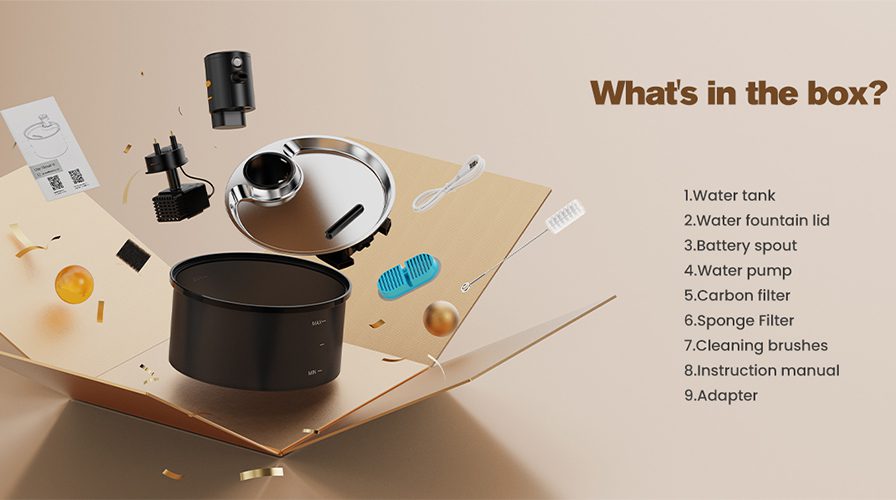
If you’ve ever wondered what goes into making a cat water fountain — beyond the sleek exterior that ends up on your counter — the answer involves multiple specialized manufacturing processes working together. Understanding these processes isn’t just interesting; it’s essential for buyers who need to evaluate product quality, compare manufacturers, and make informed sourcing decisions.
Here’s how a cat water fountain goes from raw materials to finished product.
The manufacturing process step by step
Step 1: Raw material procurement and inspection
Every fountain begins with raw materials — primarily food-grade plastics (PP, ABS, or AS) and 304 stainless steel for premium models. Before any production begins, incoming materials undergo inspection:
- Material certification verification — Confirming that plastics are food-grade and BPA-free, and that stainless steel meets 304 grade specifications
- Dimensional checks — Verifying that raw materials meet the tolerances required for precision molding
- Visual inspection — Identifying any defects, contamination, or inconsistencies in raw materials
This first gate is critical. Material quality determines the quality of every component that follows.
Step 2: Injection molding
The water tank, pump housing, filter compartment, and most structural components are produced through injection molding. This process involves:
- Mold design and fabrication — Creating precision steel molds that define the shape, dimensions, and surface finish of each component. High-quality molds achieve tolerances of ±0.05mm.
- Material preparation — Drying plastic pellets to remove moisture that could cause defects during molding
- Injection process — Heating plastic to its melting point and injecting it into the mold under high pressure
- Cooling and ejection — Allowing the plastic to cool and solidify before ejecting the finished component
- Quality inspection — Checking each batch for dimensional accuracy, surface defects, and structural integrity
For cat fountains, injection molding produces the water tank, pump housing, filter cage, and various internal components. The quality of the mold directly determines the fit, finish, and durability of these parts.
Step 3: Stainless steel processing (for premium models)
Premium fountains use 304 stainless steel for the water bowl and select components. This processing involves:
- Die-casting or stamping — Forming stainless steel sheets into the required shapes
- CNC machining — Precision cutting and shaping for components that require tight tolerances
- Surface finishing — Polishing to a mirror or brushed finish for aesthetic quality and hygiene
- Edge treatment — Rounding and smoothing all edges to eliminate sharp points
- Quality inspection — Verifying dimensions, surface finish, and material integrity
Stainless steel processing requires specialized equipment and expertise. Manufacturers who handle this in-house can control quality and timelines more effectively than those who outsource.
Step 4: Pump production and testing
The water pump is the heart of the fountain, and its quality determines noise level, reliability, and product lifespan. In-house pump production involves:
- Motor assembly — Installing the electromagnetic motor, impeller, and magnetic coupling
- Seal installation — Ensuring waterproof seals that prevent leaks
- Performance testing — Verifying flow rate, pressure, and power consumption
- Noise testing — Confirming operation below 35dB
- Burn-in testing — Running the pump continuously for extended periods (typically 48-72 hours) to identify early failures
- 100% function testing — Every pump is tested individually before installation
This step is where manufacturers who produce their own pumps gain a significant advantage. In-house pump manufacturing allows for tight quality control, rapid iteration, and the ability to customize pump specifications for different fountain designs.
Step 5: Filter production
Multi-stage filter cartridges are assembled from multiple filtration layers:
- Mesh pre-filter — Captures large debris (hair, food particles)
- Activated carbon layer — Absorbs chlorine, odors, and organic compounds
- Ion exchange resin — Softens water by removing minerals
- Fine mesh post-filter — Catches any remaining particles
- Housing assembly — Encasing the filter media in a food-safe housing
Each layer serves a specific function, and the quality of the filter directly impacts water purity and cat health.
Step 6: Assembly
Final assembly is where all components come together:
- Station-by-station assembly — Each assembly line station adds specific components in sequence
- In-line quality checks — Visual and functional inspections at each station
- Electronics installation — Installing sensors, control boards, LED indicators, and battery compartments (for rechargeable models)
- Wiring and connection — Connecting all electrical components to the control board
- Functional testing — Testing the complete assembled unit for water flow, sensor response, and electrical function
Modern assembly lines use automated processes for repetitive tasks while maintaining human oversight for quality-critical operations.
Step 7: Final quality control
Before packaging, assembled fountains undergo comprehensive quality control:
- AQL (Acceptable Quality Level) inspection — Statistical sampling to verify product quality meets standards
- Function testing — Every unit is tested for water flow, pump operation, sensor response, and mode switching
- Leak testing — Verifying that all water-contact seals are watertight
- Safety testing — Confirming electrical safety and material compliance
- Cosmetic inspection — Checking for scratches, defects, or finish inconsistencies
Step 8: Packaging
Packaging is the final step:
- Protective packaging design — Creating packaging that survives shipping and handling
- Drop testing — Verifying that packaging protects the product during transit
- Manual and accessory inclusion — Adding instruction manuals, filter cartridges, power adapters, and other accessories
- Labeling — Applying product labels with certification marks, specifications, and barcode/SKU information
- Final inspection — Verifying package completeness and presentation
Why manufacturing process matters for buyers
Understanding the manufacturing process helps buyers:
- Evaluate quality claims — Knowing what questions to ask about each step
- Compare manufacturers — Identifying which manufacturers control which processes
- Identify risks — Understanding where quality failures typically occur
- Negotiate effectively — Having informed conversations about specifications and expectations
Manufacturers who operate all these processes under one roof — from injection molding to pump production to final assembly — offer significant advantages in quality control, lead time, and flexibility.
The bottom line
Manufacturing a quality cat water fountain involves multiple specialized processes, each requiring specific equipment, expertise, and quality control. For buyers, understanding these processes is the foundation of making informed sourcing decisions.
See HS Smart Pet’s manufacturing facility or request a quote to learn how our vertically integrated production delivers quality cat water fountains.
