
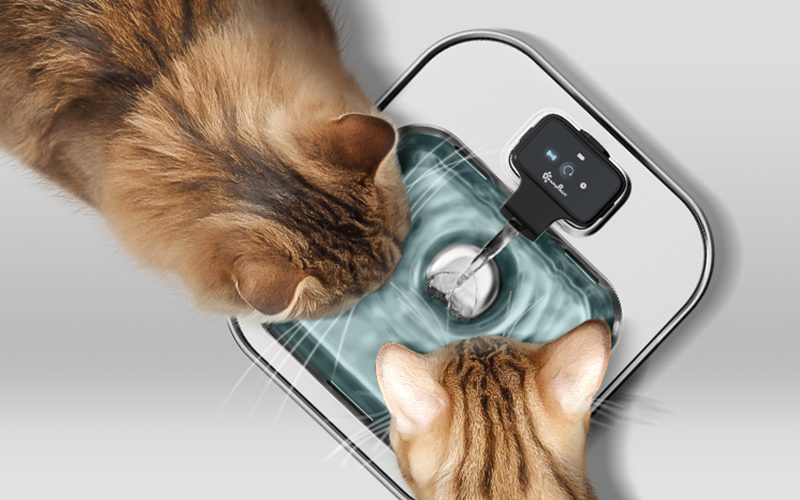
Bringing a cat water fountain from concept to market involves far more than just assembling parts. The manufacturing process spans multiple stages — from initial design and engineering through prototyping, tooling, production, and quality control. Each stage introduces decisions that affect product quality, cost, timeline, and market readiness.
For brand owners and product developers, understanding this process is essential. It helps you set realistic expectations, evaluate manufacturing partners, and make informed decisions about design, materials, and features.
Stage 1: Concept and design
Every fountain starts with a concept — a set of requirements that define what the product should be.
Functional requirements define what the product does: water capacity, operating modes (timer, sensor, continuous), pump specifications, filtration system, and power source (corded, battery, or both).
Material requirements specify what the product is made of: food-grade plastics for the tank, 304 stainless steel for the water bowl, and specific plastic grades for internal components.
Design requirements determine how the product looks and fits into the user’s home: dimensions, color options, surface finish, and overall aesthetic.
Certification requirements specify which standards the product must meet: CE, FCC, RoHS, UKCA, and food-contact material compliance for the target market.
The design phase typically involves industrial designers, mechanical engineers, and electronics engineers working together to create a product that balances aesthetics, functionality, manufacturability, and cost.
Stage 2: Engineering and prototyping
Once the design is finalized, engineering translates it into production-ready specifications:
3D CAD modeling creates detailed digital models of every component, with precise dimensions, tolerances, and material specifications.
Simulation and analysis tests structural integrity, fluid dynamics (water flow patterns), and thermal performance before any physical prototype is made.
Functional prototyping produces physical samples using rapid prototyping methods (3D printing, CNC machining) to evaluate fit, function, and aesthetics.
Design iteration refines the prototype based on testing results — adjusting tolerances, modifying flow paths, improving sensor placement, or simplifying assembly.
This stage typically takes 2-4 weeks and produces several prototype iterations before the design is finalized.
Stage 3: Tooling and mold fabrication
For mass production, injection molds must be fabricated for each plastic component. This is often the most time-consuming and expensive stage of the manufacturing process:
Mold design creates the detailed engineering specifications for each mold, including cavity layout, gate locations, cooling channels, and ejection systems.
Mold fabrication involves CNC machining of high-quality steel to create the mold cavities. Precision molds achieve tolerances of ±0.05mm and can produce millions of shots before requiring maintenance.
Mold testing (T1, T2 samples) verifies that the mold produces components that meet dimensional and cosmetic specifications. Adjustments are made as needed.
Mold approval confirms that the produced components meet all requirements and the mold is ready for production.
Tooling typically takes 25-40 days depending on complexity, and represents a significant upfront investment (often $3,000-$15,000 per mold depending on size and complexity).
Stage 4: Pre-production sampling
Before committing to mass production, pre-production samples are produced and evaluated:
T1 samples are the first parts produced from the production molds. They may require adjustments.
T2 samples incorporate corrections from T1 feedback. These are typically the samples used for buyer approval.
Production samples are produced from the actual production line using production materials and processes. These samples should match what mass production will deliver.
Sample approval is a critical gate. Once approved, mass production begins using the approved samples as the quality benchmark.
Stage 5: Mass production
With tooling approved and samples confirmed, mass production proceeds through several coordinated operations:
Material preparation — Drying and staging plastic pellets, cutting stainless steel sheets, and preparing electronic components
Injection molding — Producing plastic components at high volume using the approved molds. Typical cycle times are 15-45 seconds per shot depending on component size and complexity.
Stainless steel processing — Die-casting, stamping, and polishing stainless steel components for premium fountain models.
Pump assembly and testing — Assembling water pumps in-house and testing each unit for flow rate, noise level, and reliability.
Filter assembly — Producing filter cartridges with the specified filtration layers.
Electronics assembly — Assembling control boards, sensors, and wiring harnesses.
Final assembly — Combining all components on automated assembly lines with station-by-station quality checks.
Quality control — Multi-stage testing including function testing, leak testing, and cosmetic inspection.
Stage 6: Packaging and shipping
Packaging design creates retail-ready packaging that protects the product during shipping and presents it attractively to consumers.
Packaging production produces boxes, inserts, manuals, and accessories at volume.
Product packaging places finished fountains into packaging with all accessories and documentation.
Drop testing verifies that packaged products survive shipping conditions.
Container loading packs products into shipping containers for ocean freight or air cargo.
Timeline expectations
A typical cat water fountain manufacturing timeline:
- Design and engineering: 2-4 weeks
- Tooling and mold fabrication: 25-40 days
- Pre-production sampling: 1-2 weeks
- Mass production: 2-3 weeks (depending on order quantity)
- Packaging and shipping: 1-2 weeks
Total: approximately 8-12 weeks from design approval to shipment for a new OEM product with custom tooling. ODM products using existing designs can be produced in 3-5 weeks since tooling is already in place.
What to look for in a manufacturing partner
The manufacturing process reveals a lot about a manufacturer’s capabilities:
Vertical integration — Does the manufacturer control injection molding, pump production, stainless steel processing, filter assembly, and final assembly under one roof? This reduces lead times and improves quality control.
Tooling expertise — Quality molds are the foundation of quality products. Look for manufacturers with in-house mold design and fabrication capabilities.
Testing infrastructure — Comprehensive testing at every stage — from pump burn-in testing to final function testing — separates quality manufacturers from cost-cutters.
Sample availability — Reputable manufacturers provide clear sample timelines and welcome buyer involvement in the approval process.
The bottom line
The cat water fountain manufacturing process involves multiple stages, each requiring specific expertise and quality control. Understanding this process helps you set realistic timelines, evaluate manufacturing partners, and make informed decisions about your product.
Contact HS Smart Pet to learn how our end-to-end manufacturing capabilities support your product from concept to delivery.
