
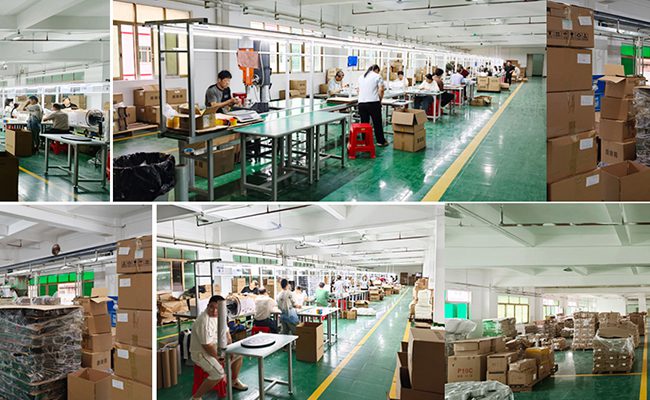
China is the world’s largest producer of cat water fountains, and for good reason. The combination of specialized manufacturing infrastructure, experienced workforce, and vertically integrated production capabilities makes Chinese factories the primary source for global pet product brands.
But not all Chinese factories are equal. Understanding what happens inside a quality cat water fountain factory helps buyers evaluate potential partners and make informed sourcing decisions.
The factory layout
A modern cat water fountain factory is organized into specialized workshops, each handling a specific part of the production process. Here’s what you’ll find inside a vertically integrated facility like HS Smart Pet’s 30,000 m² factory:
Injection molding workshop
This is where plastic components take shape. The workshop houses 20+ injection molding machines ranging from small-tonnage machines for precision parts to large-tonnage machines for water tanks and structural components.
What happens here: Plastic pellets are dried, heated to their melting point, and injected into precision steel molds under high pressure. The result is components like water tanks, pump housings, filter cages, and structural parts — all produced with tight dimensional tolerances.
Key quality indicators: Look for clean, organized machine layouts; temperature-controlled material storage; and systematic mold maintenance schedules. Quality factories track shot counts and perform preventive mold maintenance.
Water pump workshop
The pump is the most critical component of any fountain. In-house pump production is a significant differentiator — many factories outsource pump manufacturing, which introduces quality variability and dependency on third-party suppliers.
What happens here: Electromagnetic motors are assembled, impellers are balanced, waterproof seals are installed, and each pump undergoes individual testing. The workshop includes dedicated testing stations for flow rate, noise level, and power consumption.
Key quality indicators: Every pump should be tested individually — not just sampled. Look for factories that conduct 100% function testing and maintain detailed test records for each pump.
Stainless steel workshop
For premium fountain models, stainless steel processing happens in a dedicated workshop equipped with die-casting machines, CNC equipment, and polishing stations.
What happens here: 304 stainless steel sheets are cut, formed, polished, and finished to create water bowls and select components. The process requires precision to ensure proper fit with plastic components produced in the injection workshop.
Key quality indicators: Material grade verification (304 stainless steel), surface finish quality (mirror or brushed), and edge treatment (smooth, no sharp points).
Filter workshop
Filtration systems are assembled from multiple layers of filter media, each serving a specific function.
What happens here: Mesh pre-filters, activated carbon layers, ion exchange resin, and fine post-filters are assembled into cartridge housings. The process requires precise layering and consistent media quality to ensure filtration effectiveness.
Key quality indicators: Consistent filter dimensions, proper media layering, and sealed housings that prevent bypass (water flowing around the filter rather than through it).
Assembly workshop
The assembly workshop is where all components come together into finished products.
What happens here: Automated assembly lines combine plastic components, stainless steel parts, pumps, electronics, and filters into complete fountains. Each station performs a specific assembly task and includes quality checks.
Key quality indicators: Automated lines with station-by-station quality checks; clean, organized workstations; and systematic quality recording.
Packaging workshop
Packaging is the final step before shipping.
What happens here: Finished fountains are placed into retail-ready packaging with accessories (power adapters, filter cartridges, instruction manuals). Packaging is designed to protect the product during shipping.
Key quality indicators: Drop-test certified packaging, complete accessory inclusion, and clean, professional presentation.
Quality systems throughout the factory
Quality control isn’t a single step — it’s embedded throughout the production process:
Incoming material inspection — All raw materials are verified before entering production.
In-process quality checks — Visual and functional inspections at each production stage.
Pump burn-in testing — Pumps run continuously for 48-72 hours to identify early failures.
100% function testing — Every assembled fountain is tested for water flow, sensor response, and mode switching.
AQL inspection — Statistical sampling to verify overall product quality before packaging.
Final inspection — Random sampling of packaged products to verify completeness and presentation.
ISO 9001 certification provides the framework for these quality systems, ensuring consistency and traceability.
What to look for during a factory visit
If you’re evaluating a Chinese cat water fountain factory, here’s what to observe:
Organization and cleanliness. Well-organized factories with clean workspaces generally produce better quality products. Clutter and disorganization often correlate with quality problems.
Equipment maintenance. Well-maintained equipment produces more consistent results. Look for systematic maintenance schedules and documented maintenance records.
Testing infrastructure. Comprehensive testing equipment — including noise meters, flow meters, electrical safety testers, and pressure testers — indicates a commitment to quality.
Worker training. Experienced, well-trained workers produce better quality products. Ask about training programs and worker turnover rates.
Quality documentation. Factories that maintain detailed quality records — test results, inspection reports, non-conformance tracking — demonstrate systematic quality management.
Virtual factory tours
Many quality manufacturers offer virtual factory tours for buyers who can’t visit in person. These tours typically include video walkthroughs of each workshop, close-ups of equipment and processes, and explanations of quality systems.
A virtual tour is a good starting point, but it should eventually be complemented by an in-person visit or third-party audit for significant production commitments.
The bottom line
A quality cat water fountain factory is organized into specialized workshops with clear processes, comprehensive testing, and systematic quality management. Understanding what happens inside these factories helps you evaluate potential partners and make informed sourcing decisions.
Schedule a virtual tour of HS Smart Pet’s factory or learn more about our manufacturing capabilities.
