
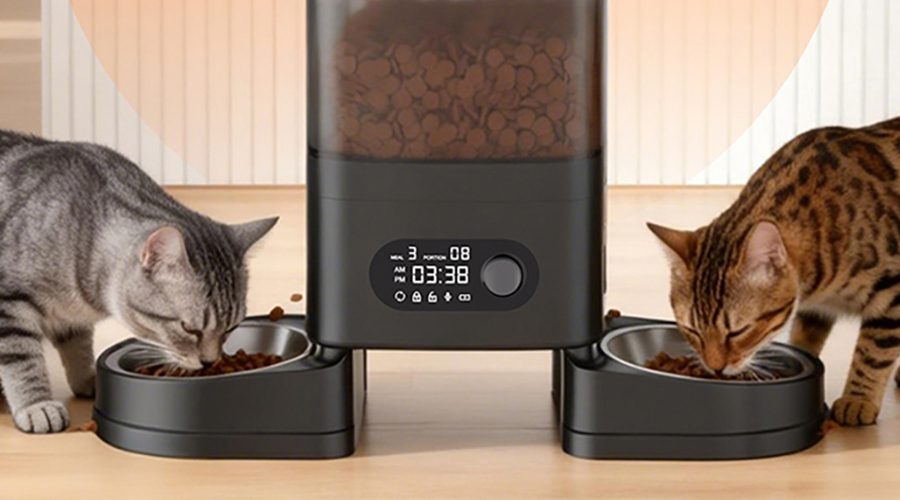
Automatic cat feeders range from simple mechanical timer models to sophisticated WiFi-connected smart devices. Understanding how they work helps you choose the right product and use it effectively.
Basic mechanical feeders
The simplest automatic feeders use a mechanical timer and gravity:
Timer mechanism — A clockwork or battery-powered timer triggers the food release at programmed times.
Gravity dispensing — Food drops from a hopper into a bowl when a gate opens.
Fixed portions — Portion size is determined by the gate opening and hopper design, with limited adjustability.
These feeders are affordable ($15-$30) but offer limited flexibility and no remote control.
Electronic timer feeders
Step up from mechanical models, electronic feeders offer:
Digital programming — LCD display and buttons for setting feeding schedules.
Multiple meals — Program 1-6 meals per day with specific times.
Portion control — Adjustable portion sizes (typically measured in cups or grams).
Voice recording — Record a call message to attract your cat at mealtime.
Desiccant compartment — Keeps food fresh between meals.
These feeders provide more flexibility and precision than mechanical models, typically priced at $20-$40.
WiFi smart feeders
The most advanced feeders add connectivity and app control:
WiFi connectivity — Connect to your home WiFi network for remote control via smartphone app.
App control — Schedule feeding times, set portions, and monitor intake from anywhere.
Tuya App integration — Many smart feeders use the Tuya platform, providing a proven, reliable app experience.
Dual hopper systems — Two separate food compartments that can dispense different food types or amounts.
Camera integration — Built-in camera for remote monitoring during feeding.
Real-time notifications — Get alerts when feeding is complete, food is low, or the hopper is jammed.
Multi-user access — Share feeding responsibilities with family members through the app.
HS Smart Pet’s smart feeders use Tuya App WiFi control with dual food outlets, voice recording, and desiccant compartments.
The dispensing mechanism
Regardless of smart features, all feeders share a common dispensing mechanism:
Hopper — Stores dry food (typically 3L-6L capacity).
Rotor or paddle — A rotating mechanism inside the hopper pushes food toward the outlet.
Motor — Drives the rotor at controlled speed and duration to dispense precise portions.
Outlet — Guides dispensed food into the bowl.
Bowl — Receives the dispensed food.
The quality of the dispensing mechanism determines portion accuracy and jam resistance. Quality feeders use precision-molded rotors and food-grade materials to handle different kibble sizes reliably.
Food freshness
Keeping food fresh is critical for automatic feeders:
Desiccant compartment — Absorbs moisture to keep food crunchy and fresh.
Sealed hopper — Prevents air exposure during storage.
Quick dispensing — Food is dispensed and consumed quickly, minimizing exposure.
Safety features
Quality feeders include safety features:
Locking hopper lid — Prevents cats from opening the hopper and overeating.
Jam detection — Alerts you if food gets stuck in the dispensing mechanism.
Anti-choke design — Portion sizes designed to prevent choking.
Backup battery — Ensures feeding continues during power outages.
The bottom line
Automatic cat feeders range from simple mechanical timers to sophisticated WiFi-connected devices. The technology you choose depends on your needs — basic meal scheduling, precise portion control, or remote monitoring and app control.
