
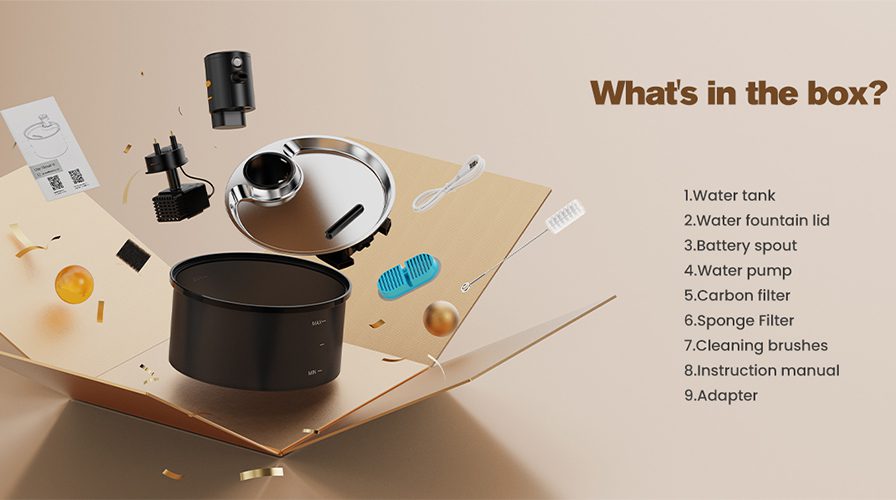
OEM (Original Equipment Manufacturing) is the pathway to creating a cat water fountain that’s uniquely yours — your design, your features, your brand identity. But OEM manufacturing involves more complexity than private label or ODM, and understanding the process is essential for brands considering this route.
What OEM means in cat product manufacturing
In the cat water fountain context, OEM means you’re commissioning a manufacturer to produce a fountain based on your custom design specifications. This can range from modifying an existing design to creating an entirely new product from scratch.
What’s customizable in OEM:
- Physical design — Shape, dimensions, color, surface finish
- Material selection — Plastic type, stainless steel grade, silicone components
- Pump specifications — Flow rate, noise level, power consumption
- Filtration system — Number of stages, media types, filter cartridge design
- Electronics — Control board design, sensor types, LED indicators
- Firmware — Operating modes, timing sequences, power management
- App integration — WiFi connectivity, Tuya or custom app, feature set
- Packaging — Box design, inserts, manuals, branding elements
- Certifications — CE, FCC, RoHS, UKCA, food-contact compliance
The OEM manufacturing process
Step 1: Design specification
You provide detailed specifications for your product. This can include:
- CAD files or detailed drawings
- Functional requirements
- Material specifications
- Electronic schematics (for smart products)
- Target price point
- Certification requirements
- Volume expectations
If you don’t have complete design files, many manufacturers offer design engineering services to help develop specifications from your concept.
Step 2: Design review and quotation
The manufacturer reviews your specifications and provides:
- Technical feasibility assessment — Can the design be manufactured as specified?
- Cost breakdown — Tooling cost, per-unit cost, minimum order quantity
- Timeline estimate — Development, tooling, and production timelines
- Risk assessment — Potential challenges or design modifications needed
This review often results in design suggestions — experienced manufacturers know what works in production and can identify issues before they become expensive problems.
Step 3: Tooling and prototyping
Once the design is approved:
- Injection molds are fabricated for all plastic components
- Stamping dies are created for stainless steel components (if applicable)
- Electronic components are sourced and assembled
- Prototypes are produced from production tooling for approval
Tooling typically takes 25-40 days depending on the number and complexity of molds.
Step 4: Sample approval
Pre-production samples are produced and submitted for your approval:
- Dimensional accuracy — Do all components fit together properly?
- Functional performance — Does the fountain operate as specified?
- Aesthetic quality — Does the finish, color, and overall appearance meet expectations?
- Certification testing — Do samples meet required standards?
Sample approval is the critical gate before mass production begins.
Step 5: Mass production
With samples approved, production proceeds:
- Material procurement — Ordering production quantities of all materials
- Production run — Running the production line at volume
- Quality control — Multi-stage testing at each production stage
- Packaging — Producing retail-ready packaging with your branding
Step 6: Quality verification and shipping
- AQL inspection — Statistical sampling to verify product quality
- Packaging verification — Confirming package completeness and presentation
- Shipping — Container loading and transportation to your warehouse
OEM vs ODM: which is right for you?
Choose OEM when:
- You have a unique design concept that doesn’t exist in the market
- You need specific features or specifications not available in existing products
- Your brand identity requires a distinctive product design
- You’re willing to invest in tooling and development time
Choose ODM when:
- You want to enter the market quickly with lower upfront investment
- Existing designs meet your requirements with minor modifications
- You want to test the market before committing to custom development
- Your priority is branding and packaging rather than product design
What OEM costs
OEM manufacturing involves several cost categories:
- Design and engineering: $2,000-$10,000
- Tooling (molds): $5,000-$50,000 depending on complexity
- Samples: $500-$2,000
- Per-unit cost: Varies based on specifications and volume
ODM alternatives typically cost significantly less upfront because existing tooling is reused.
Tips for successful OEM projects
Start with clear specifications. The more detailed your requirements, the fewer surprises during production.
Leverage manufacturer expertise. Experienced manufacturers know what works in production. Their design suggestions often improve quality and reduce cost.
Plan for iterations. First articles rarely perfectly match expectations. Budget time and money for refinements.
Invest in tooling quality. Cheap molds produce inconsistent parts and require frequent maintenance. Quality tooling pays for itself over the production run.
Maintain open communication. Regular updates, prompt feedback on samples, and clear decision-making keep the project on track.
The bottom line
OEM manufacturing gives you complete control over your product design and features. It requires more investment and timeline than ODM, but delivers a truly unique product that differentiates your brand.
Contact HS Smart Pet to discuss OEM cat water fountain manufacturing — from custom design to mass production.
